


Texas

Texas | |
|---|---|
| Nickname: The Lone Star State | |
| Motto: Friendship | |
| Anthem: "Texas, Our Texas" | |
 Map of the United States with Texas highlighted | |
| Country | United States |
| Before statehood | Republic of Texas |
| Admitted to the Union | December 29, 1845 (28th) |
| Capital | Austin |
| Largest city | Houston |
| Largest county or equivalent | Harris |
| Largest metro and urban areas | Dallas–Fort Worth |
| Government | |
| • Governor | Greg Abbott (R) |
| • Lieutenant Governor | Dan Patrick (R) |
| Legislature | Texas Legislature |
| • Upper house | Senate |
| • Lower house | House of Representatives |
| Judiciary | Supreme Court of Texas (Civil) Texas Court of Criminal Appeals (Criminal) |
| U.S. senators | John Cornyn (R) Ted Cruz (R) |
| U.S. House delegation | 25 Republicans 13 Democrats (list) |
| Area | |
| • Total | 268,596[1] sq mi (695,662 km2) |
| • Land | 261,232[1] sq mi (676,587 km2) |
| • Water | 7,365[1] sq mi (19,075 km2) 2.7% |
| • Rank | 2nd |
| Dimensions | |
| • Length | 801[2] mi (1,289 km) |
| • Width | 773[2] mi (1,244 km) |
| Elevation | 1,700 ft (520 m) |
| Highest elevation | 8,751 ft (2,667.4 m) |
| Lowest elevation | 0 ft (0 m) |
| Population (2023) | |
| • Total | 30,503,301[5] |
| • Rank | 2nd |
| • Density | 114/sq mi (42.9/km2) |
| • Rank | 26th |
| • Median household income | $66,963[6] |
| • Income rank | 22nd |
| Demonym(s) | Texan Texian (archaic) Tejano (usually only used for Hispanics) |
| Language | |
| • Official language | None |
| • Spoken language | |
| Time zones | |
| Majority of state | UTC−06:00 (Central) |
| • Summer (DST) | UTC−05:00 (CDT) |
| El Paso, Hudspeth, and northwestern Culberson counties | UTC−07:00 (Mountain) |
| • Summer (DST) | UTC−06:00 (MDT) |
| USPS abbreviation | TX |
| ISO 3166 code | US-TX |
| Traditional abbreviation | Tex. |
| Latitude | 25°50′ N to 36°30′ N |
| Longitude | 93°31′ W to 106°39′ W |
| Website | texas |
| List of state symbols | |
|---|---|
 | |
 | |
| Slogan | The Friendly State |
| Living insignia | |
| Bird | Northern mockingbird (Mimus polyglottos) |
| Fish | Guadalupe bass (Micropterus treculii) |
| Flower | Bluebonnet (Lupinus spp., namely Texas bluebonnet, L. texensis) |
| Insect | Monarch butterfly (Danaus plexippus) |
| Mammal | Texas longhorn, nine-banded armadillo (Dasypus novemcinctus) |
| Mushroom | Texas star (Chorioactis geaster) |
| Reptile | Texas horned lizard (Phrynosoma cornutum) |
| Tree | Pecan (Carya illinoinensis) |
| Inanimate insignia | |
| Food | Chili |
| Game | Texas 42 dominoes |
| Instrument | Guitar |
| Shell | Lightning whelk (Busycon perversum pulleyi) |
| Ship | USS Texas |
| Soil | Houston Black |
| Sport | Rodeo |
| Other | Molecule: Buckyball (For more, see article) |
| State route marker | |
 | |
| State quarter | |
 Released in 2004 | |
| Lists of United States state symbols | |
Texas (/ˈtɛksəs/ TEK-səss, locally also /ˈtɛksɪz/ TEK-siz;[8] Spanish: Texas or Tejas,[b] pronounced [ˈtexas]) is the most populous state in the South Central region of the United States. It borders Louisiana to the east, Arkansas to the northeast, Oklahoma to the north, New Mexico to the west, and the Mexican states of Chihuahua, Coahuila, Nuevo León, and Tamaulipas to the south and southwest. Texas has a coastline on the Gulf of Mexico to the southeast. Covering 268,596 square miles (695,660 km2), and with over 30 million residents as of 2023,[10][11][12] it is the second-largest U.S. state by both area and population.
Texas is nicknamed the Lone Star State for its former status as an independent republic. The Lone Star can be found on the Texas state flag and the Texas state seal.[13] Spain was the first European country to claim and control the area of Texas. Following a short-lived colony controlled by France, Mexico controlled the territory until 1836 when Texas won its independence, becoming the Republic of Texas. In 1845, Texas joined the United States as the 28th state.[14] The state's annexation set off a chain of events that led to the Mexican–American War in 1846. Following victory by the United States, Texas remained a slave state until the American Civil War, when it declared its secession from the Union in early 1861 before officially joining the Confederate States of America on March 2. After the Civil War and the restoration of its representation in the federal government, Texas entered a long period of economic stagnation.
Historically, four major industries shaped the Texas economy prior to World War II: cattle and bison, cotton, timber, and oil.[15] Before and after the Civil War, the cattle industry—which Texas came to dominate—was a major economic driver and created the traditional image of the Texas cowboy. In the later 19th century, cotton and lumber grew to be major industries as the cattle industry became less lucrative. Ultimately, the discovery of major petroleum deposits (Spindletop in particular) initiated an economic boom that became the driving force behind the economy for much of the 20th century. Texas developed a diversified economy and high tech industry during the mid-20th century. As of 2022[update], it has the most Fortune 500 company headquarters (53) in the United States.[16][17] With a growing base of industry, the state leads in many industries, including tourism, agriculture, petrochemicals, energy, computers and electronics, aerospace, and biomedical sciences. Texas has led the U.S. in state export revenue since 2002 and has the second-highest gross state product.
The Dallas–Fort Worth metroplex and Greater Houston areas are the nation's fourth and fifth-most populous urban regions respectively. Its capital city is Austin. Due to its size and geologic features such as the Balcones Fault, Texas contains diverse landscapes common to both the U.S. Southern and the Southwestern regions.[18] Most population centers are in areas of former prairies, grasslands, forests, and the coastline. Traveling from east to west, terrain ranges from coastal swamps and piney woods, to rolling plains and rugged hills, to the desert and mountains of the Big Bend.
Etymology
The name Texas, based on the Caddo word táy:shaʼ (/tə́jːʃaʔ/) 'friend', was applied, in the spelling Tejas or Texas,[19][20][21][1] by the Spanish to the Caddo themselves, specifically the Hasinai Confederacy.[22]
During Spanish colonial rule, in the 18th century, the area was known as Nuevas Filipinas ('New Philippines') and Nuevo Reino de Filipinas ('New Kingdom of the Philippines'),[23] or as provincia de los Tejas ('province of the Tejas'),[24] later also provincia de Texas (or de Tejas), ('province of Texas').[25][23] It was incorporated as provincia de Texas into the Mexican Empire in 1821, and declared a republic in 1836. The Royal Spanish Academy recognizes both spellings, Tejas and Texas, as Spanish-language forms of the name.[26]
The English pronunciation with /ks/ is unetymological, contrary to the historical value of the letter x (/ʃ/) in Spanish orthography. Alternative etymologies of the name advanced in the late 19th century connected the name Texas with the Spanish word teja, meaning 'roof tile', the plural tejas being used to designate Indigenous Pueblo settlements.[27] A 1760s map by Jacques-Nicolas Bellin shows a village named Teijas on the Trinity River, close to the site of modern Crockett.[27]
History
Precontact era
| History of Texas | ||||||||||||||||||
|---|---|---|---|---|---|---|---|---|---|---|---|---|---|---|---|---|---|---|
 | ||||||||||||||||||
| Timeline | ||||||||||||||||||
|
||||||||||||||||||
 Texas portal Texas portal | ||||||||||||||||||

Texas lies between two major cultural spheres of Pre-Columbian North America: the Southwestern and the Plains areas. Archaeologists have found that three major Indigenous cultures lived in this territory, and reached their developmental peak before the first European contact. These were:[28] the Ancestral Puebloans from the upper Rio Grande region, centered west of Texas; the Mississippian culture, also known as Mound Builders, which extended along the Mississippi River Valley east of Texas; and the civilizations of Mesoamerica, which were centered south of Texas. Influence of Teotihuacan in northern Mexico peaked around AD 500 and declined between the 8th and 10th centuries.
When Europeans arrived in the Texas region, the language families present in the state were Caddoan, Atakapan, Athabaskan, Coahuiltecan, and Uto-Aztecan, in addition to several language isolates such as Tonkawa. Uto-Aztecan Puebloan and Jumano peoples lived neared the Rio Grande in the western portion of the state and the Athabaskan-speaking Apache tribes lived throughout the interior. The agricultural, mound-building Caddo controlled much of the northeastern part of the state, along the Red, Sabine, and Neches River basins.[29][30] Atakapan peoples such as the Akokisa and Bidai lived along the northeastern Gulf Coast; the Karankawa lived along the central coast.[31] At least one tribe of Coahuiltecans, the Aranama, lived in southern Texas. This entire culture group, primarily centered in northeastern Mexico, is now extinct.
No culture was dominant across all of present-day Texas, and many peoples inhabited the area.[32] Native American tribes who have lived inside the boundaries of present-day Texas include the Alabama, Apache, Atakapan, Bidai, Caddo, Aranama, Comanche, Choctaw, Coushatta, Hasinai, Jumano, Karankawa, Kickapoo, Kiowa, Tonkawa, and Wichita.[33][34] Many of these peoples migrated from the north or east during the colonial period, such as the Choctaw, Alabama-Coushatta, and Delaware.[29]
The region was primarily controlled by the Spanish until the Texas Revolution. They were most interested in relationships with the Caddo, who were—like the Spanish—a settled, agricultural people. Several Spanish missions were opened in Caddo territory, but a lack of interest in Christianity among the Caddo meant that few were converted. Positioned between French Louisiana and Spanish Texas, the Caddo maintained relations with both, but were closer with the French.[35] After Spain took control of Louisiana, most of the missions in eastern Texas were closed and abandoned.[36] The United States obtained Louisiana following the 1803 Louisiana Purchase and began convincing tribes to self-segregate from whites by moving west; facing an overflow of native peoples in Missouri and Arkansas, they were able to negotiate with the Caddo to allow several displaced peoples to settle on unused lands in eastern Texas. These included the Muscogee, Houma Choctaw, Lenape and Mingo Seneca, among others, who came to view the Caddoans as saviors.[37][38]
The temperament of Native American tribes affected the fates of European explorers and settlers in that land.[39] Friendly tribes taught newcomers how to grow local crops, prepare foods, and hunt wild game. Warlike tribes resisted the settlers.[39] Prior treaties with the Spanish forbade either side from militarizing its native population in any potential conflict between the two nations. Several outbreaks of violence between Native Americans and Texans started to spread in the prelude to the Texas Revolution. Texans accused tribes of stealing livestock. While no proof was found,[29] those in charge of Texas at the time attempted to publicly blame and punish the Caddo, with the U.S. government trying to keep them in check. The Caddo never turned to violence because of the situation, except in cases of self-defense.[37]
By the 1830s, the U.S. had drafted the Indian Removal Act, which was used to facilitate the Trail of Tears. Fearing retribution, Indian Agents all over the eastern U.S. tried to convince all Indigenous peoples to uproot and move west. This included the Caddo of Louisiana and Arkansas. Following the Texas Revolution, the Texans chose to make peace with the Indigenous people, but did not honor former land claims or agreements.[citation needed] The first president of Texas, Sam Houston, aimed to cooperate and make peace with Native tribes, but his successor, Mirabeau B. Lamar, took a much more hostile stance. Hostility towards Natives by white Texans prompted the movement of most Native populations north into what would become Indian Territory (modern Oklahoma).[29][37] Only the Alabama-Coushatta would remain in the parts of Texas subject to white settlement, though the Comanche would continue to control most of the western half of the state until their defeat in the 1870s and 1880s.[40]
Colonization
The first historical document related to Texas was a map of the Gulf Coast, created in 1519 by Spanish explorer Alonso Álvarez de Pineda.[41] Nine years later, shipwrecked Spanish explorer Álvar Núñez Cabeza de Vaca and his cohort became the first Europeans in what is now Texas.[42][43] Cabeza de Vaca reported that in 1528, when the Spanish landed in the area, "half the natives died from a disease of the bowels and blamed us."[44] Cabeza de Vaca also made observations about the way of life of the Ignaces Natives of Texas.[c][46] Francisco Vázquez de Coronado described another encounter with native people in 1541.[d][48]
The expedition of Hernando de Soto entered into Texas from the east, seeking a route to Mexico. They passed through the Caddo lands but turned back after reaching the River of Daycao (possibly the Brazos or Colorado), beyond which point the Native peoples were nomadic and did not have the agricultural stores to feed the expedition.[49][50]
European powers ignored the area until accidentally settling there in 1685. Miscalculations by René-Robert Cavelier de La Salle resulted in his establishing the colony of Fort Saint Louis at Matagorda Bay rather than along the Mississippi River.[51] The colony lasted only four years before succumbing to harsh conditions and hostile natives.[52] A small band of survivors traveled eastward into the lands of the Caddo, but La Salle was killed by disgruntled expedition members.[53]
In 1690 Spanish authorities, concerned that France posed a competitive threat, constructed several missions in East Texas among the Caddo.[54] After Caddo resistance, the Spanish missionaries returned to Mexico.[55] When France began settling Louisiana, in 1716 Spanish authorities responded by founding a new series of missions in East Texas.[56] Two years later, they created San Antonio as the first Spanish civilian settlement in the area.[57]

Hostile native tribes and distance from nearby Spanish colonies discouraged settlers from moving to the area. It was one of New Spain's least populated provinces.[59] In 1749, the Spanish peace treaty with the Lipan Apache angered many tribes,[60] including the Comanche, Tonkawa, and Hasinai.[61] The Comanche signed a treaty with Spain in 1785 and later helped to defeat the Lipan Apache and Karankawa tribes.[62][63] With numerous missions being established, priests led a peaceful conversion of most tribes. By the end of the 18th century only a few nomadic tribes had not converted.[64]

.png)
When the United States purchased Louisiana from France in 1803, American authorities insisted the agreement also included Texas. The boundary between New Spain and the United States was finally set in 1819 at the Sabine River, the modern border between Texas and Louisiana.[65] Eager for new land, many U.S. settlers refused to recognize the agreement. Several filibusters raised armies to invade the area west of the Sabine River.[66] Marked by the War of 1812, some men who had escaped from the Spanish, held (Old) Philippines had immigrated to and also passed through Texas (New Philippines)[67] and reached Louisiana where Philippine exiles aided the United States in the defense of New Orleans against a British invasion, with Filipinos in the Saint Malo settlement assisting Jean Lafitte in the Battle of New Orleans.[68]
In 1821, the Mexican War of Independence included the Texas territory, which became part of Mexico.[69] Due to its low population, the territory was assigned to other states and territories of Mexico; the core territory was part of the state of Coahuila y Tejas, but other parts of today's Texas were part of Tamaulipas, Chihuahua, or the Mexican Territory of Santa Fe de Nuevo México.[70]
Hoping more settlers would reduce the near-constant Comanche raids, Mexican Texas liberalized its immigration policies to permit immigrants from outside Mexico and Spain.[71] Large swathes of land were allotted to empresarios, who recruited settlers from the United States, Europe, and the Mexican interior, primarily the U.S. Austin's settlers, the Old Three Hundred, made places along the Brazos River in 1822.[72] The population of Texas grew rapidly. In 1825, Texas had about 3,500 people, with most of Mexican descent.[73] By 1834, the population had grown to about 37,800 people, with only 7,800 of Mexican descent.[74]
Many immigrants openly flouted Mexican law, especially the prohibition against slavery. Combined with United States' attempts to purchase Texas, Mexican authorities decided in 1830 to prohibit continued immigration from the United States.[75] However, illegal immigration from the United States into Mexico continued to increase the population of Texas.[76] New laws also called for the enforcement of customs duties angering native Mexican citizens (Tejanos) and recent immigrants alike.[77] The Anahuac Disturbances in 1832 were the first open revolt against Mexican rule, coinciding with a revolt in Mexico against the nation's president.[78] Texians sided with the federalists against the government and drove all Mexican soldiers out of East Texas.[79] They took advantage of the lack of oversight to agitate for more political freedom. Texians met at the Convention of 1832 to discuss requesting independent statehood, among other issues.[80] The following year, Texians reiterated their demands at the Convention of 1833.[81]
Republic
Within Mexico, tensions continued between federalists and centralists. In early 1835, wary Texians formed Committees of Correspondence and Safety.[82] The unrest erupted into armed conflict in late 1835 at the Battle of Gonzales.[83] This launched the Texas Revolution. Texians elected delegates to the Consultation, which created a provisional government.[84] The provisional government soon collapsed from infighting, and Texas was without clear governance for the first two months of 1836.[85]

Mexican President Antonio López de Santa Anna personally led an army to end the revolt.[86] General José de Urrea defeated all the Texian resistance along the coast culminating in the Goliad massacre.[87] López de Santa Anna's forces, after a thirteen-day siege, overwhelmed Texian defenders at the Battle of the Alamo. News of the defeats sparked panic among Texas settlers.[88]

The newly elected Texian delegates to the Convention of 1836 quickly signed a declaration of independence on March 2, forming the Republic of Texas. After electing interim officers, the Convention disbanded.[89] The new government joined the other settlers in Texas in the Runaway Scrape, fleeing from the approaching Mexican army.[88]
After several weeks of retreat, the Texian Army commanded by Sam Houston attacked and defeated López de Santa Anna's forces at the Battle of San Jacinto.[90] López de Santa Anna was captured and forced to sign the Treaties of Velasco, ending the war.[91] The Constitution of the Republic of Texas prohibited the government from restricting slavery or freeing slaves, and required free people of African descent to leave the country.[92]
Political battles raged between two factions of the new Republic. The nationalist faction, led by Mirabeau B. Lamar, advocated the continued independence of Texas, the expulsion of the Native Americans, and the expansion of the Republic to the Pacific Ocean. Their opponents, led by Sam Houston, advocated the annexation of Texas to the United States and peaceful co-existence with Native Americans. The conflict between the factions was typified by an incident known as the Texas Archive War.[93] With wide popular support, Texas first applied for annexation to the United States in 1836, but its status as a slaveholding country caused its admission to be controversial and it was initially rebuffed. This status, and Mexican diplomacy in support of its claims to the territory, also complicated Texas's ability to form foreign alliances and trade relationships.[94]
The Comanche Indians furnished the main Native American opposition to the Texas Republic, manifested in multiple raids on settlements.[95] Mexico launched two small expeditions into Texas in 1842. The town of San Antonio was captured twice and Texans were defeated in battle in the Dawson massacre. Despite these successes, Mexico did not keep an occupying force in Texas, and the republic survived.[96] The cotton price crash of the 1840s depressed the country's economy.[94]
Statehood

Texas was finally annexed when the expansionist James K. Polk won the election of 1844.[97] On December 29, 1845, the U.S. Congress admitted Texas to the U.S.[98] After Texas's annexation, Mexico broke diplomatic relations with the United States. While the United States claimed Texas's border stretched to the Rio Grande, Mexico claimed it was the Nueces River leaving the Rio Grande Valley under contested Texan sovereignty.[98] While the former Republic of Texas could not enforce its border claims, the United States had the military strength and the political will to do so. President Polk ordered General Zachary Taylor south to the Rio Grande on January 13, 1846. A few months later Mexican troops routed an American cavalry patrol in the disputed area in the Thornton Affair starting the Mexican–American War. The first battles of the war were fought in Texas: the Siege of Fort Texas, Battle of Palo Alto and Battle of Resaca de la Palma. After these decisive victories, the United States invaded Mexican territory, ending the fighting in Texas.[99]

The Treaty of Guadalupe Hidalgo ended the two-year war. In return for US$18,250,000, Mexico gave the U.S. undisputed control of Texas, ceded the Mexican Cession in 1848, most of which today is called the American Southwest, and Texas's borders were established at the Rio Grande.[99]
The Compromise of 1850 set Texas's boundaries at their present position: Texas ceded its claims to land which later became half of present-day New Mexico,[100] a third of Colorado, and small portions of Kansas, Oklahoma, and Wyoming to the federal government, in return for the assumption of $10 million of the old republic's debt.[100] Post-war Texas grew rapidly as migrants poured into the cotton lands of the state.[101] They also brought or purchased enslaved African Americans, whose numbers tripled in the state from 1850 to 1860, from 58,000 to 182,566.[102]
Civil War to late 19th century
Texas re-entered war following the election of 1860. During this time, Black people comprised 30 percent of the state's population, and they were overwhelmingly enslaved.[103] When Abraham Lincoln was elected, South Carolina seceded from the Union; five other Deep South states quickly followed. A state convention considering secession opened in Austin on January 28, 1861. On February 1, by a vote of 166–8, the convention adopted an Ordinance of Secession. Texas voters approved this Ordinance on February 23, 1861. Texas joined the newly created Confederate States of America on March 4, 1861, ratifying the permanent C.S. Constitution on March 23.[1][104]
Not all Texans favored secession initially, although many of the same would later support the Southern cause. Texas's most notable Unionist was the state governor, Sam Houston. Not wanting to aggravate the situation, Houston refused two offers from President Lincoln for Union troops to keep him in office. After refusing to swear an oath of allegiance to the Confederacy, Houston was deposed.[105]
While far from the major battlefields of the American Civil War, Texas contributed large numbers of soldiers and equipment.[106] Union troops briefly occupied the state's primary port, Galveston. Texas's border with Mexico was known as the "backdoor of the Confederacy" because trade occurred at the border, bypassing the Union blockade.[107] The Confederacy repulsed all Union attempts to shut down this route,[106] but Texas's role as a supply state was marginalized in mid-1863 after the Union capture of the Mississippi River. The final battle of the Civil War was fought at Palmito Ranch, near Brownsville, Texas, and saw a Confederate victory.[108][109]
Texas descended into anarchy for two months between the surrender of the Army of Northern Virginia and the assumption of authority by Union General Gordon Granger. Violence marked the early months of Reconstruction.[106] Juneteenth commemorates the announcement of the Emancipation Proclamation in Galveston by General Gordon Granger, almost two and a half years after the original announcement.[110][111] President Johnson, in 1866, declared the civilian government restored in Texas.[112] Despite not meeting Reconstruction requirements, Congress resumed allowing elected Texas representatives into the federal government in 1870. Social volatility continued as the state struggled with agricultural depression and labor issues.[113]
Like most of the South, the Texas economy was devastated by the War. However, since the state had not been as dependent on slaves as other parts of the South, it was able to recover more quickly. The culture in Texas during the later 19th century exhibited many facets of a frontier territory. The state became notorious as a haven for people from other parts of the country who wanted to escape debt, war tensions, or other problems. "Gone to Texas" was a common expression for those fleeing the law in other states. Nevertheless, the state also attracted many businessmen and other settlers with more legitimate interests.[114]
The cattle industry continued to thrive, though it gradually became less profitable. Cotton and lumber became major industries creating new economic booms in various regions. Railroad networks grew rapidly as did the port at Galveston as commerce expanded. The lumber industry quickly expanded and was Texas' largest industry prior to the 20th century.[115]
Early to mid-20th century

In 1900, Texas suffered the deadliest natural disaster in U.S. history during the Galveston hurricane.[116] On January 10, 1901, the first major oil well in Texas, Spindletop, was found south of Beaumont. Other fields were later discovered nearby in East Texas, West Texas, and under the Gulf of Mexico. The resulting "oil boom" transformed Texas.[117] Oil production averaged three million barrels per day at its peak in 1972.[118]
In 1901, the Democratic-dominated state legislature passed a bill requiring payment of a poll tax for voting, which effectively disenfranchised most Black and many poor White and Latino people. In addition, the legislature established white primaries, ensuring minorities were excluded from the formal political process. The number of voters dropped dramatically, and the Democrats crushed competition from the Republican and Populist parties.[119][120] The Socialist Party became the second-largest party in Texas after 1912,[121] coinciding with a large socialist upsurge in the United States during fierce battles in the labor movement and the popularity of national heroes like Eugene V. Debs. The socialists' popularity soon waned after their vilification by the federal government for their opposition to U.S. involvement in World War I.[122][123]
The Great Depression and the Dust Bowl dealt a double blow to the state's economy, which had significantly improved since the Civil War. Migrants abandoned the worst-hit sections of Texas during the Dust Bowl years. Especially from this period on, Black people left Texas in the Great Migration to get work in the Northern United States or California and to escape segregation.[103] In 1940, Texas was 74% White, 14.4% Black, and 11.5% Hispanic.[124]
World War II had a dramatic impact on Texas, as federal money poured in to build military bases, munitions factories, detention camps and Army hospitals; 750,000 Texans left for service; the cities exploded with new industry; and hundreds of thousands of poor farmers left the fields for much better-paying war jobs, never to return to agriculture.[125][126] Texas manufactured 3.1 percent of total United States military armaments produced during World War II, ranking eleventh among the 48 states.[127]
Texas modernized and expanded its system of higher education through the 1960s. The state created a comprehensive plan for higher education, funded in large part by oil revenues, and a central state apparatus designed to manage state institutions more efficiently. These changes helped Texas universities receive federal research funds.[128]
Mid-20th to early 21st century
Beginning around the mid-20th century, Texas began to transform from a rural and agricultural state to one urban and industrialized.[129] The state's population grew quickly during this period, with large levels of migration from outside the state.[129] As a part of the Sun Belt, Texas experienced strong economic growth, particularly during the 1970s and early 1980s.[129] Texas's economy diversified, lessening its reliance on the petroleum industry.[129] By 1990, Hispanics and Latino Americans overtook Blacks to become the largest minority group.[129] Texas has the largest Black population with over 3.9 million.[130]
During the late 20th century, the Republican Party replaced the Democratic Party as the dominant party in the state.[129] Beginning in the early 21st century, metropolitan areas including Dallas–Fort Worth and Greater Austin became centers for the Texas Democratic Party in statewide and national elections as liberal policies became more accepted in urban areas.[131][132][133][134]
From the mid-2000s to 2019, Texas gained an influx of business relocations and regional headquarters from companies in California.[135][136][137][138] Texas became a major destination for migration during the early 21st century and was named the most popular state to move for three consecutive years.[139] Another study in 2019 determined Texas's growth rate at 1,000 people per day.[140]
During the COVID-19 pandemic in Texas, the first confirmed case of the virus in Texas was announced on March 4, 2020.[141] On April 27, 2020, Governor Greg Abbott announced phase one of re-opening the economy.[142] Amid a rise in COVID-19 cases in autumn 2020, Abbott refused to enact further lockdowns.[143][144] In November 2020, Texas was selected as one of four states to test Pfizer's COVID-19 vaccine distribution.[145] As of February 2, 2021, there had been over 2.4 million confirmed cases in Texas, with at least 37,417 deaths.[146]
During February 13–17, 2021, the state faced a major weather emergency as Winter Storm Uri hit the state, as well as most of the Southeastern and Midwestern United States.[147][148] Historically high power usage across the state caused the state's power grid to become overworked and ERCOT (the main operator of the Texas Interconnection grid) declared an emergency and began to implement rolling blackouts across Texas, causing a power crisis.[149][150][151] Over 3 million Texans were without power and over 4 million were under boil-water notices.[152]
Geography


Texas is the second-largest U.S. state by area, after Alaska, and the largest state within the contiguous United States, at 268,820 square miles (696,200 km2). If it were an independent country, Texas would be the 39th-largest.[153] It ranks 27th worldwide amongst country subdivisions by size.
Texas is in the south central part of the United States. The Rio Grande forms a natural border with the Mexican states of Chihuahua, Coahuila, Nuevo León, and Tamaulipas to the south. The Red River forms a natural border with Oklahoma and Arkansas to the north. The Sabine River forms a natural border with Louisiana to the east. The Texas Panhandle has an eastern border with Oklahoma at 100° W, a northern border with Oklahoma at 36°30' N and a western border with New Mexico at 103° W. El Paso lies on the state's western tip at 32° N and the Rio Grande.[100]
With 10 climatic regions, 14 soil regions and 11 distinct ecological regions, regional classification becomes complicated with differences in soils, topography, geology, rainfall, and plant and animal communities.[154] One classification system divides Texas, in order from southeast to west, into the following: Gulf Coastal Plains, Interior Lowlands, Great Plains, and Basin and Range Province.[155]
The Gulf Coastal Plains region wraps around the Gulf of Mexico on the southeast section of the state. Vegetation in this region consists of thick piney woods. The Interior Lowlands region consists of gently rolling to hilly forested land and is part of a larger pine-hardwood forest. The Cross Timbers region and Caprock Escarpment are part of the Interior Lowlands.[155]

The Great Plains region in Central Texas spans through the state's panhandle and Llano Estacado to the state's hill country near Lago Vista and Austin. This region is dominated by prairie and steppe. "Far West Texas" or the "Trans-Pecos" region is the state's Basin and Range Province. The most varied of the regions, this area includes Sand Hills, the Stockton Plateau, desert valleys, wooded mountain slopes and desert grasslands.[156]
Texas has 3,700 named streams and 15 major rivers,[157][158] with the Rio Grande as the largest. Other major rivers include the Pecos, the Brazos, Colorado, and Red River. While Texas has few natural lakes, Texans have built more than a hundred artificial reservoirs.[159]
The size and unique history of Texas make its regional affiliation debatable; it can be considered a Southern or a Southwestern state, or both. The vast geographic, economic, and cultural diversity within the state itself prohibits easy categorization of the whole state into a recognized region of the United States. Notable extremes range from East Texas which is often considered an extension of the Deep South, to Far West Texas which is generally acknowledged to be part of the interior Southwest.[160]
Geology


Texas is the southernmost part of the Great Plains, which ends in the south against the folded Sierra Madre Occidental of Mexico. The continental crust forms a stable Mesoproterozoic craton which changes across a broad continental margin and transitional crust into true oceanic crust of the Gulf of Mexico. The oldest rocks in Texas date from the Mesoproterozoic and are about 1,600 million years old.[161]
This margin existed until Laurasia and Gondwana collided in the Pennsylvanian subperiod to form Pangea.[162] Pangea began to break up in the Triassic, but seafloor spreading to form the Gulf of Mexico occurred only in the mid- and late Jurassic. The shoreline shifted again to the eastern margin of the state and the Gulf of Mexico's passive margin began to form. Today 9 to 12 miles (14 to 19 km) of sediments are buried beneath the Texas continental shelf and a large proportion of remaining US oil reserves are here. The incipient Gulf of Mexico basin was restricted and seawater often evaporated completely to form thick evaporite deposits of Jurassic age. These salt deposits formed salt dome diapirs, and are found in East Texas along the Gulf coast.[163]
East Texas outcrops consist of Cretaceous and Paleogene sediments which contain important deposits of Eocene lignite. The Mississippian and Pennsylvanian sediments in the north; Permian sediments in the west; and Cretaceous sediments in the east, along the Gulf coast and out on the Texas continental shelf contain oil. Oligocene volcanic rocks are found in far west Texas in the Big Bend area. A blanket of Miocene sediments known as the Ogallala formation in the western high plains region is an important aquifer.[164] Located far from an active plate tectonic boundary, Texas has no volcanoes and few earthquakes.[165]
Wildlife
Texas is the home to 65 species of mammals, 213 species of reptiles and amphibians, including the American green tree frog, and the greatest diversity of bird life in the United States—590 native species in all.[166] At least 12 species have been introduced and now reproduce freely in Texas.[167]
Texas plays host to several species of wasps, including an abundance of Polistes exclamans,[168] and is an important ground for the study of Polistes annularis.[169]
During the spring Texas wildflowers such as the state flower, the bluebonnet, line highways throughout Texas. During the Johnson Administration the first lady, Lady Bird Johnson, worked to draw attention to Texas wildflowers.[170]
Climate

The large size of Texas and its location at the intersection of multiple climate zones gives the state highly variable weather. The Panhandle of the state has colder winters than North Texas, while the Gulf Coast has mild winters. Texas has wide variations in precipitation patterns. El Paso, on the western end of the state, averages 8.7 inches (220 mm) of annual rainfall,[171] while parts of southeast Texas average as much as 64 inches (1,600 mm) per year.[172] Dallas in the North Central region averages a more moderate 37 inches (940 mm) per year.[173]
Snow falls multiple times each winter in the Panhandle and mountainous areas of West Texas, once or twice a year in North Texas, and once every few years in Central and East Texas. Snow falls south of San Antonio or on the coast only in rare circumstances. Of note is the 2004 Christmas Eve snowstorm, when 6 inches (150 mm) of snow fell as far south as Kingsville, where the average high temperature in December is 65 °F.[174]
Night-time summer temperatures range from the upper 50s °F (14 °C) in the West Texas mountains to 80 °F (27 °C) in Galveston.[175][176]
The table below consists of averages for August (generally the warmest month) and January (generally the coldest) in selected cities in various regions of the state.
| Location | August (°F) | August (°C) | January (°F) | January (°C) |
|---|---|---|---|---|
| Houston | 94/75 | 34/24 | 63/54 | 17/12 |
| San Antonio | 96/74 | 35/23 | 63/40 | 17/5 |
| Dallas | 96/77 | 36/25 | 57/37 | 16/3 |
| Austin | 97/74 | 36/23 | 61/45 | 16/5 |
| El Paso | 92/67 | 33/21 | 57/32 | 14/0 |
| Laredo | 100/77 | 37/25 | 67/46 | 19/7 |
| Amarillo | 89/64 | 32/18 | 50/23 | 10/−4 |
| Brownsville | 94/76 | 34/24 | 70/51 | 21/11 |
Storms
Thunderstorms strike Texas often, especially the eastern and northern portions of the state. Tornado Alley covers the northern section of Texas. The state experiences the most tornadoes in the United States, an average of 139 a year. These strike most frequently in North Texas and the Panhandle.[178] Tornadoes in Texas generally occur in April, May, and June.[179]
Some of the most destructive hurricanes in U.S. history have impacted Texas. A hurricane in 1875 killed about 400 people in Indianola, followed by another hurricane in 1886 that destroyed the town. These events allowed Galveston to take over as the chief port city. The 1900 Galveston hurricane subsequently devastated that city, killing about 8,000 people or possibly as many as 12,000 in the deadliest natural disaster in U.S. history.[116] In 2017, Hurricane Harvey made landfall in Rockport as a Category 4 Hurricane, causing significant damage there. Its unprecedented amounts of rain over the Greater Houston area resulted in widespread and catastrophic flooding that inundated hundreds of thousands of homes. Harvey ultimately became the costliest hurricane worldwide, causing an estimated $198.6 billion in damage, surpassing the cost of Hurricane Katrina.[180]
Other devastating Texas hurricanes include the 1915 Galveston hurricane, Hurricane Audrey in 1957, Hurricane Carla in 1961, Hurricane Beulah in 1967, Hurricane Alicia in 1983, Hurricane Rita in 2005, and Hurricane Ike in 2008. Tropical storms have also caused their share of damage: Allison in 1989 and again during 2001, Claudette in 1979, and Tropical Storm Imelda in 2019.[181][182][183]
There is no substantial physical barrier between Texas and the polar region. Although it is unusual, it is possible for arctic or polar air masses to penetrate Texas,[184][185] as occurred during the February 13–17, 2021 North American winter storm.[186][187] Usually, prevailing winds in North America will push polar air masses to the southeast before they reach Texas. Because such intrusions are rare, and, perhaps, unexpected, they may result in crises such as the 2021 Texas power crisis.
Greenhouse gases
As of 2017[update], Texas emitted the most greenhouse gases in the U.S.[188] As of 2017[update] the state emits about 1,600 billion pounds (707 million metric tons) of carbon dioxide annually.[188] As an independent state, Texas would rank as the world's seventh-largest producer of greenhouse gases.[189] Causes of the state's vast greenhouse gas emissions include the state's large number of coal power plants and the state's refining and manufacturing industries.[189] In 2010, there were 2,553 "emission events" which poured 44.6 million pounds (20,200 metric tons) of contaminants into the Texas sky.[190]
Administrative divisions
| Largest city in Texas by year[191] | |
|---|---|
| Year(s) | City |
| 1850–1870 | San Antonio[192] |
| 1870–1890 | Galveston[193] |
| 1890–1900 | Dallas[191] |
| 1900–1930 | San Antonio[192] |
| 1930–present | Houston[194] |

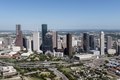
The state has three cities with populations exceeding one million: Houston, San Antonio, and Dallas.[195] These three rank among the 10 most populous cities of the United States. As of 2020, six Texas cities had populations greater than 600,000. Austin, Fort Worth, and El Paso are among the 20 largest U.S. cities. Texas has four metropolitan areas with populations greater than a million: Dallas–Fort Worth–Arlington, Houston–Sugar Land–The Woodlands, San Antonio–New Braunfels, and Austin–Round Rock–San Marcos. The Dallas–Fort Worth and Houston metropolitan areas number about 7.5 million and 7 million residents as of 2019, respectively.[196]
Three interstate highways—I-35 to the west (Dallas–Fort Worth to San Antonio, with Austin in between), I-45 to the east (Dallas to Houston), and I-10 to the south (San Antonio to Houston) define the Texas Urban Triangle region. The region of 60,000 square miles (160,000 km2) contains most of the state's largest cities and metropolitan areas as well as 17 million people, nearly 75 percent of Texas's total population.[197] Houston and Dallas have been recognized as world cities.[198] These cities are spread out amongst the state.[199]
In contrast to the cities, unincorporated rural settlements known as colonias often lack basic infrastructure and are marked by poverty.[200] The office of the Texas Attorney General stated, in 2011, that Texas had about 2,294 colonias, and estimates about 500,000 lived in the colonias. Hidalgo County, as of 2011, has the largest number of colonias.[201] Texas has the largest number of people living in colonias of all states.[200]
Texas has 254 counties, more than any other state.[202] Each county runs on Commissioners' Court system consisting of four elected commissioners (one from each of four precincts in the county, roughly divided according to population) and a county judge elected at large from the entire county. County government runs similar to a "weak" mayor-council system; the county judge has no veto authority, but votes along with the other commissioners.[203][204]
Although Texas permits cities and counties to enter "interlocal agreements" to share services, the state does not allow consolidated city-county governments, nor does it have metropolitan governments. Counties are not granted home rule status; their powers are strictly defined by state law. The state does not have townships—areas within a county are either incorporated or unincorporated. Incorporated areas are part of a municipality. The county provides limited services to unincorporated areas and to some smaller incorporated areas. Municipalities are classified either "general law" cities or "home rule".[205] A municipality may elect home rule status once it exceeds 5,000 population with voter approval.[206]
Texas also permits the creation of "special districts", which provide limited services. The most common is the school district, but can also include hospital districts, community college districts, and utility districts. Municipal, school district, and special district elections are nonpartisan,[207] though the party affiliation of a candidate may be well-known. County and state elections are partisan.[208]
| Rank | Name | County | Pop. | Rank | Name | County | Pop. | ||
|---|---|---|---|---|---|---|---|---|---|
 Houston  San Antonio |
1 | Houston | Harris | 2,302,878 | 11 | Laredo | Webb | 256,187 |  Dallas  Austin |
| 2 | San Antonio | Bexar | 1,472,909 | 12 | Irving | Dallas | 254,715 | ||
| 3 | Dallas | Dallas | 1,299,544 | 13 | Garland | Dallas | 240,854 | ||
| 4 | Austin | Travis | 974,447 | 14 | Frisco | Collin | 219,587 | ||
| 5 | Fort Worth | Tarrant | 956,709 | 15 | McKinney | Collin | 207,507 | ||
| 6 | El Paso | El Paso | 677,456 | 16 | Grand Prairie | Dallas | 201,843 | ||
| 7 | Arlington | Tarrant | 394,602 | 17 | Amarillo | Potter | 201,291 | ||
| 8 | Corpus Christi | Nueces | 316,239 | 18 | Brownsville | Cameron | 189,382 | ||
| 9 | Plano | Collin | 289,547 | 19 | Killeen | Bell | 159,172 | ||
| 10 | Lubbock | Lubbock | 263,930 | 20 | Denton | Denton | 150,353 | ||
Demographics
| Census | Pop. | Note | %± |
|---|---|---|---|
| 1850 | 212,592 | — | |
| 1860 | 604,215 | 184.2% | |
| 1870 | 818,579 | 35.5% | |
| 1880 | 1,591,749 | 94.5% | |
| 1890 | 2,235,527 | 40.4% | |
| 1900 | 3,048,710 | 36.4% | |
| 1910 | 3,896,542 | 27.8% | |
| 1920 | 4,663,228 | 19.7% | |
| 1930 | 5,824,715 | 24.9% | |
| 1940 | 6,414,824 | 10.1% | |
| 1950 | 7,711,194 | 20.2% | |
| 1960 | 9,579,677 | 24.2% | |
| 1970 | 11,196,730 | 16.9% | |
| 1980 | 14,229,191 | 27.1% | |
| 1990 | 16,986,510 | 19.4% | |
| 2000 | 20,851,820 | 22.8% | |
| 2010 | 25,145,561 | 20.6% | |
| 2020 | 29,145,505 | 15.9% | |
| 2023 (est.) | 30,503,301 | 4.7% | |
| 1910–2020[5] | |||

The resident population of Texas was 29,145,505 in the 2020 census, a 15.9% increase since the 2010 census.[210][211] At the 2020 census, the apportioned population of Texas stood at 29,183,290.[212] The 2023 Texas Population Estimate program estimated the population was 30,503,301 on July 1, 2023.[213] In 2010, Texas had a census population of 25,145,561.[214] Texas is the second-most populous state in the United States after California and the only other U.S. state to surpass a total estimated population of 30 million people as of July 2, 2022.[215][216]
In 2015, Texas had 4.7 million foreign-born residents, about 17% of the population and 21.6% of the state workforce.[217] The major countries of origin for Texan immigrants were Mexico (55.1% of immigrants), India (5%), El Salvador (4.3%), Vietnam (3.7%), and China (2.3%).[217] Of immigrant residents, 35.8 percent were naturalized U.S. citizens.[217] As of 2018, the population increased to 4.9 million foreign-born residents or 17.2% of the state population, up from 2,899,642 in 2000.[218]
In 2014, there were an estimated 1.7 million undocumented immigrants in Texas, making up 35% of the total Texas immigrant population and 6.1% of the total state population.[217] In addition to the state's foreign-born population, an additional 4.1 million Texans (15% of the state's population) were born in the United States and had at least one immigrant parent.[217]
According to the American Community Survey's 2019 estimates, 1,739,000 residents were undocumented immigrants, a decrease of 103,000 since 2014 and increase of 142,000 since 2016. Of the undocumented immigrant population, 951,000 have resided in Texas from less than 5 up to 14 years. An estimated 788,000 lived in Texas from 15 to 19 and 20 years or more.[219]
Texas's Rio Grande Valley has seen significant migration from across the U.S.–Mexico border. During the 2014 crisis, many Central Americans, including unaccompanied minors traveling alone from Guatemala, Honduras, and El Salvador, reached the state, overwhelming Border Patrol resources for a time. Many sought asylum in the United States.[220][221]
Texas's population density as of 2010 is 96.3 people per square mile (37.2 people/km2) which is slightly higher than the average population density of the U.S. as a whole, at 87.4 people per square mile (33.7 people/km2). In contrast, while Texas and France are similarly sized geographically, the European country has a population density of 301.8 people per square mile (116.5 people/km2). Two-thirds of all Texans live in major metropolitan areas such as Houston.
According to HUD's 2022 Annual Homeless Assessment Report, there were an estimated 24,432 homeless people in Texas.[222][223]
Race and ethnicity
.svg)
| Non-Hispanic White 20–30% 30–40% 40–50% 50–60% 60–70% 70–80% 80–90% | Hispanic or Latino 40–50% 50–60% 60–70% 70–80% 80–90% 90%+ |
| Race and ethnicity[224] | Alone | Total | ||
|---|---|---|---|---|
| Hispanic or Latino[e] | — | 40.2% | ||
| Non-Hispanic White | 39.7% | 39.8% | ||
| African American | 11.8% | 12.8% | ||
| Asian | 5.4% | 6.1% | ||
| Native American | 0.3% | 1.4% | ||
| Pacific Islander | 0.1% | 0.2% | ||
| Other | 0.4% | 1.0% | ||
In 2019, non-Hispanic Whites represented 41.2% of Texas's population, reflecting a national demographic shift.[225][226][227] Black people made up 12.9%, American Indians and Alaska Natives 1.0%, Asian Americans 5.2%, Native Hawaiians and other Pacific Islanders 0.1%, some other race 0.2%, and two or more races 1.8%. Hispanics or Latino Americans of any race made up 39.7% of the estimated population.[228]
At the 2020 census, the racial and ethnic composition of the state was 42.5% White (39.8% non-Hispanic White), 11.8% Black, 5.4% Asian, 0.3% American Indian and Alaska Native, 0.1% Native Hawaiian and other Pacific Islander, 13.6% some other race, 17.6% two or more races, and 40.2% Hispanic and Latino American of any race.[229][230]
In 2010, 49% of all births were Hispanics; 35% were non-Hispanic White; 11.5% were non-Hispanic Black, and 4.3% were Asians/Pacific Islanders.[231] Based on U.S. Census Bureau data released in February 2011, for the first time in recent history, Texas's White population is below 50% (45%) and Hispanics grew to 38%. Between 2000 and 2010, the total population grew by 20.6%, but Hispanics and Latino Americans grew by 65%, whereas non-Hispanic Whites grew by only 4.2%.[232] Texas has the fifth highest rate of teenage births in the nation and a plurality of these are to Hispanics or Latinos.[233][234] As of 2022, Hispanics and Latinos of any race replaced the non-Hispanic White population as the largest share of the state's population.[235]
Languages
| Language | Population (as of 2010)[236] |
|---|---|
| Spanish | 29.2% |
| Vietnamese | 0.8% |
| Chinese | 0.6% |
| German | 0.3% |
| Tagalog | 0.3% |
| French | 0.3% |
| Korean and Urdu (tied) | 0.2% |
| Hindi | 0.2% |
| Arabic | 0.2% |
| Niger-Congo languages | 0.2% |
The most common accent or dialect spoken by natives throughout Texas is sometimes referred to as Texan English, itself a sub-variety of a broader category of American English known as Southern American English.[237][238] Creole language is spoken in some parts of East Texas.[239] In some areas of the state—particularly in the large cities—Western American English and General American English, is increasingly common. Chicano English—due to a growing Hispanic population—is widespread in South Texas, while African-American English is especially notable in historically minority areas of urban Texas.
At the 2020 American Community Survey's estimates, 64.9% of the population spoke only English, and 35.1% spoke a language other than English.[240] Roughly 30% of the total population spoke Spanish. By 2021, approximately 50,546 Texans spoke French or a French-creole language. German and other West Germanic languages were spoken by 49,565 residents; Russian, Polish, and other Slavic languages by 37,444; Korean by 31,673; Chinese 86,370; Vietnamese 92,410; Tagalog 40,124; and Arabic by 47,170 Texans.[241]
At the census of 2010, 65.8% (14,740,304) of Texas residents age 5 and older spoke only English at home, while 29.2% (6,543,702) spoke Spanish, 0.8 percent (168,886) Vietnamese, and Chinese (which includes Cantonese and Mandarin) was spoken by 0.6% (122,921) of the population over five.[236] Other languages spoken include German (including Texas German) by 0.3% (73,137), Tagalog with 0.3% (64,272) speakers, and French (including Cajun French) was spoken by 0.3% (55,773) of Texans.[236] Reportedly, Cherokee is the most widely spoken Native American language in Texas.[242] In total, 34.2% (7,660,406) of Texas's population aged five and older spoke a language at home other than English as of 2006.[236]
Religion
With the coming of Spanish Catholic and American Protestant missionary societies,[244] Indigenous American Indian religions and spiritual traditions dwindled. Since then, colonial and present-day Texas has become a predominantly Christian state, with 75.5% of the population identifying as such according to the Public Religion Research Institute in 2020.[245]

Among its majority Christian populace, the largest Christian denomination as of 2014 has been the Catholic Church, per the Pew Research Center at 23% of the population, although Protestants collectively constituted 50% of the Christian population in 2014;[246] in the 2020 study by the Public Religion Research Institute, the Catholic Church's membership increased to encompassing 28% of the population identifying with a religious or spiritual belief.[245] At the 2020 Association of Religion Data Archives study, there were 5,905,142 Catholics in the state.[247] The largest Catholic jurisdictions in Texas are the Archdiocese of Galveston–Houston—the first and oldest Latin Church diocese in Texas[248]—the dioceses of Dallas and Fort Worth, and the Archdiocese of San Antonio.

Being part of the strongly, socially conservative Bible Belt,[249] Protestants as a whole declined to 47% of the population in the 2020 study by the Public Religion Research Institute. Predominantly-white Evangelical Protestantism declined to 14% of the Protestant Christian population. Mainline Protestants in contrast made up 15% of Protestant Texas. Hispanic or Latino American-dominated Protestant churches and historically Black or African American Protestantism grew to a collective 13% of the Protestant population.
Evangelical Protestants were 31% of the population in 2014, and Baptists were the largest Evangelical tradition (14%);[246] according to the 2014 study, they made up the second-largest Mainline Protestant group behind Methodists (4%). Nondenominational and interdenominational Protestant Christians were the second largest Evangelical group (7%) followed by Pentecostals (4%). The largest Evangelical Baptists in the state were the Southern Baptist Convention (9%) and independent Baptists (3%). The Assemblies of God USA was the largest Evangelical Pentecostal denomination in 2014. Among Mainline Protestants, the United Methodist Church was the largest denomination (4%) and the American Baptist Churches USA comprised the second-largest Mainline Protestant group (2%).
According to the Pew Research Center in 2014, the state's largest historically African American Christian denominations were the National Baptist Convention (USA) and the Church of God in Christ. Black Methodists and other Christians made up less than 1 percent each of the Christian demographic. Other Christians made up 1 percent of the total Christian population, and the Eastern and Oriental Orthodox formed less than 1 percent of the statewide Christian populace. The Church of Jesus Christ of Latter-day Saints is the largest nontrinitarian Christian group in Texas alongside the Jehovah's Witnesses.[246]
Among its Protestant population, the Association of Religion Data Archives in 2020 determined Southern Baptists numbered 3,319,962; non-denominational Protestants 2,405,786 (including Christian Churches and Churches of Christ, and the Churches of Christ altogether numbering 2,758,353); and United Methodists 938,399 as the most numerous Protestant groups in the state.[247] Baptists altogether (Southern Baptists, American Baptist Associates, American Baptists, Full Gospel Baptists, General Baptists, Free Will Baptists, National Baptists, National Baptists of America, National Missionary Baptists, National Primitive Baptists, and Progressive National Baptists) numbered 3,837,306; Methodists within United Methodism, the AME, AME Zion, CME, and the Free Methodist Church numbered 1,026,453 Texans.
The same study tabulated 425,038 Pentecostals spread among the Assemblies of God, Church of God (Cleveland), and Church of God in Christ. Nontrinitarian or Oneness Pentecostals numbered 7,042 between Bible Way Church of Our Lord Jesus Christ, COOLJC, and the Pentecostal Assemblies of the World. Other Christians, including the Eastern and Oriental Orthodox, numbered 55,329 altogether, and Episcopalians numbered 134,318, although the Anglican Catholic Church, Anglican Church in America, Anglican Church in North America, Anglican Province of America, and Holy Catholic Church Anglican Rite had a collective presence in 114 churches.[250]
Non-Christian faiths accounted for 4% of the religious population in 2014, and 5% in 2020 per the Pew Research Center and Public Religion Research Institute.[246][245] Adherents of many other religions reside predominantly in the urban centers of Texas. Judaism, Islam, and Buddhism were tied as the second largest religion as of 2014 and 2020. In 2014, 18% of the state's population were religiously unaffiliated. Of the unaffiliated in 2014, an estimated 2% were atheists and 3% agnostic; in 2020, the Public Religion Research Institute noted the largest non-Christian groups were the irreligious (20%), Judaism (1%), Islam (1%), Buddhism (1%) and Hinduism, and other religions at less than 1 percent each.
In 1990, the Islamic population was about 140,000 with more recent figures putting the current number of Muslims between 350,000 and 400,000 as of 2012.[251] The Association of Religion Data Archives estimated there were 313,209 Muslims as of 2020.[247] Texas is the fifth-largest Muslim-populated state as of 2014.[252] The Jewish population was around 128,000 in 2008.[253] In 2020, the Jewish population grew to over 176,000.[254] According to ARDA's 2020 study, there were 43 Chabad synagogues; 17,513 Conservative Jews; 8,110 Orthodox Jews; and 31,378 Reform Jews. Around 146,000 adherents of religions such as Hinduism and Sikhism lived in Texas as of 2004.[255] By 2020, there were 112,153 Hindus and 20 Sikh gurdwaras; 60,882 Texans adhered to Buddhism.
Economy
.png)

As of 2022, Texas had a gross state product (GSP) of $2.4 trillion, the second highest in the U.S.[256] Its GSP is greater than the GDP of Italy, the world's 8th-largest economy.[257] The state ranks 22nd among U.S. states with a median household income of $64,034, while the poverty rate is 14.2%, making Texas the state with 14th highest poverty rate (compared to 13.15% nationally). Texas's economy is the second-largest of any country subdivision globally, behind California.
Texas's large population, an abundance of natural resources, thriving cities and leading centers of higher education have contributed to a large and diverse economy. Since oil was discovered, the state's economy has reflected the state of the petroleum industry. In recent times, urban centers of the state have increased in size, containing two-thirds of the population in 2005. The state's economic growth has led to urban sprawl and its associated symptoms.[258]
As of May 2020, during the COVID-19 pandemic, the state's unemployment rate was 13 percent.[259]
In 2010, Site Selection Magazine ranked Texas as the most business-friendly state, in part because of the state's three-billion-dollar Texas Enterprise Fund.[260] Texas has the highest number of Fortune 500 company headquarters in the United States as of 2022.[16][17] In 2010, there were 346,000 millionaires in Texas, the second-largest population of millionaires in the nation.[f][261] In 2018, the number of millionaire households increased to 566,578.[262]
Taxation
Texas has a reputation for a low tax.[263] According to the Tax Foundation, Texans' state and local tax burdens are seventh-lowest nationally; state and local taxes cost $3,580 per capita, or 8.4 percent of resident incomes.[264] Texas is one of seven states that lack a state income tax.[264][265]
Instead, the state collects revenue from property taxes (though these are collected at the county, city, and school district level; Texas has a state constitutional prohibition against a state property tax) and sales taxes. The state sales tax rate is 6.25 percent,[264][266] but local taxing jurisdictions (cities, counties, special purpose districts, and transit authorities) may also impose sales and use tax up to 2 percent for a total maximum combined rate of 8.25 percent.[267]
Texas is a "tax donor state"; in 2005, for every dollar Texans paid to the federal government in federal income taxes, the state got back about $0.94 in benefits.[264] To attract business, Texas has incentive programs worth $19 billion per year (2012); more than any other U.S. state.[268][269]
Agriculture and mining


Texas has the most farms and the highest acreage in the United States. The state is ranked No. 1 for revenue generated from total livestock and livestock products. It is ranked No. 2 for total agricultural revenue, behind California.[270] At $7.4 billion or 56.7 percent of Texas's annual agricultural cash receipts, beef cattle production represents the largest single segment of Texas agriculture. This is followed by cotton at $1.9 billion (14.6 percent), greenhouse/nursery at $1.5 billion (11.4 percent), broiler chickens at $1.3 billion (10 percent), and dairy products at $947 million (7.3 percent).[271]
Texas leads the nation in the production of cattle, horses, sheep, goats, wool, mohair and hay.[271] The state also leads the nation in production of cotton which is the number one crop grown in the state in terms of value.[270][272][273] The state grows significant amounts of cereal crops and produce.[270] Texas has a large commercial fishing industry. With mineral resources, Texas leads in creating cement, crushed stone, lime, salt, sand and gravel.[270] Texas throughout the 21st century has been hammered by drought, costing the state billions of dollars in livestock and crops.[274]
Energy
Ever since the discovery of oil at Spindletop, energy has been a dominant force politically and economically within the state.[275] If Texas were its own country it would be the sixth-largest oil producer in the world according to a 2014 study.[276]
The Railroad Commission of Texas regulates the state's oil and gas industry, gas utilities, pipeline safety, safety in the liquefied petroleum gas industry, and surface coal and uranium mining. Until the 1970s, the commission controlled the price of petroleum because of its ability to regulate Texas's oil reserves. The founders of the Organization of Petroleum Exporting Countries (OPEC) used the Texas agency as one of their models for petroleum price control.[277]
As of January 1, 2021, Texas has proved recoverable petroleum reserves of about 15.6 billion barrels (2.48×10⁹ m3) of crude oil (44% of the known U.S. reserves) and 9.5 billion barrels (1.51×10⁹ m3) of natural gas liquids.[278][279] The state's refineries can process 5.95 million barrels (946,000 m3) of oil a day.[278][279] The Port Arthur Refinery in Southeast Texas is the largest refinery in the U.S.[278] Texas is also a leader in natural gas production at 28.8 billion cubic feet (820,000,000 m3) per day, some 32% of the nation's production.[280] Texas has 102.4 trillion cubic feet (2.90×10¹² m3) of gas reserves which is 23% of the nation's gas reserves.[278][279] Many petroleum companies are based in Texas such as: ConocoPhillips,[281] EOG Resources, ExxonMobil,[282] Halliburton,[283] Hilcorp, Marathon Oil,[284] Occidental Petroleum,[285] Pioneer Natural Resources, Tesoro,[286] Valero Energy,[287] and Western Refining.[288]
According to the Energy Information Administration, Texans consume, on average, the fifth most energy (of all types) in the nation per capita and as a whole, following behind Wyoming, Alaska, Louisiana, North Dakota, and Iowa.[278]
Unlike the rest of the nation, most of Texas is on its own alternating current power grid, the Texas Interconnection. Texas has a deregulated electric service. Texas leads the nation in total net electricity production, generating 437,236 MWh in 2014, 89% more MWh than Florida, which ranked second.[289][290]
The state is a leader in renewable energy commercialization; it produces the most wind power in the nation.[278][291] In 2014, 10.6% of the electricity consumed in Texas came from wind turbines.[292] The Roscoe Wind Farm in Roscoe, Texas, is one of the world's largest wind farms with a 781.5 megawatt (MW) capacity.[293] The Energy Information Administration states the state's large agriculture and forestry industries could give Texas an enormous amount of biomass for use in biofuels. The state also has the highest solar power potential for development in the U.S.[278]
Technology

With large universities systems coupled with initiatives like the Texas Enterprise Fund and the Texas Emerging Technology Fund, a wide array of different high tech industries have developed in Texas. The Austin area is nicknamed the "Silicon Hills" and the north Dallas area the "Silicon Prairie". Many high-tech companies are located in or have their headquarters in Texas (and Austin in particular), including Dell, Inc.,[294] Borland,[295] Forcepoint,[296] Indeed.com,[297] Texas Instruments,[298] Perot Systems,[299] Rackspace and AT&T.[300][301][302]
The National Aeronautics and Space Administration's Lyndon B. Johnson Space Center (NASA JSC) is located in Southeast Houston. Both SpaceX and Blue Origin have their test facilities in Texas.[303][304] Fort Worth hosts both Lockheed Martin's Aeronautics division and Bell Helicopter Textron.[305][306] Lockheed builds the F-16 Fighting Falcon, the largest Western fighter program, and its successor, the F-35 Lightning II in Fort Worth.[307]
Commerce
Texas's affluence stimulates a strong commercial sector consisting of retail, wholesale, banking and insurance, and construction industries. Examples of Fortune 500 companies not based on Texas traditional industries are AT&T, Kimberly-Clark, Blockbuster, J. C. Penney, Whole Foods Market, and Tenet Healthcare.[308]
Nationally, the Dallas–Fort Worth area, home to the second shopping mall in the United States, has the most shopping malls per capita of any American metropolitan statistical area.[309]
Mexico, the state's largest trading partner, imports a third of the state's exports because of the North American Free Trade Agreement (NAFTA). NAFTA has encouraged the formation of maquiladoras on the Texas–Mexico border.[310]
Culture

Historically, Texas culture comes from a blend of Southern (Dixie), Western (frontier), and Southwestern (Mexican/Anglo fusion) influences, varying in degrees of such from one intrastate region to another. A popular food item, the breakfast burrito, draws from all three, having a soft flour tortilla wrapped around bacon and scrambled eggs or other hot, cooked fillings. Adding to Texas's traditional culture, established in the 18th and 19th centuries, immigration has made Texas a melting pot of cultures from around the world.[311][312]
Texas has made a strong mark on national and international pop culture. The entire state is strongly associated with the image of the cowboy shown in westerns and in country western music. The state's numerous oil tycoons are also a popular pop culture topic as seen in the hit TV series Dallas.[313]
The internationally known slogan "Don't Mess with Texas" began as an anti-littering advertisement. Since the campaign's inception in 1986, the phrase has become "an identity statement, a declaration of Texas swagger".[314]
Texas self-perception

"Texas-sized" describes something that is about the size of the U.S. state of Texas,[315][316] or something (usually but not always originating from Texas) that is large compared to other objects of its type.[317][318][319] Texas was the largest U.S. state until Alaska became a state in 1959. The phrase "everything is bigger in Texas" has been in regular use since at least 1950.[320]
Arts
.jpg)
Houston is one of only five American cities with permanent professional resident companies in all the major performing arts disciplines: the Houston Grand Opera, the Houston Symphony Orchestra, the Houston Ballet, and The Alley Theatre.[321] Known for the vibrancy of its visual and performing arts, the Houston Theater District ranks second in the country in the number of theater seats in a concentrated downtown area, with 12,948 seats for live performances and 1,480 movie seats.[321] Founded in 1892, Modern Art Museum of Fort Worth, also called "The Modern", is Texas's oldest art museum. Fort Worth also has the Kimbell Art Museum, the Amon Carter Museum, the National Cowgirl Museum and Hall of Fame, the Will Rogers Memorial Center, and the Bass Performance Hall downtown. The Arts District of Downtown Dallas has arts venues such as the Dallas Museum of Art, the Morton H. Meyerson Symphony Center, the Margot and Bill Winspear Opera House, the Trammell & Margaret Crow Collection of Asian Art, and the Nasher Sculpture Center.[322]

The Deep Ellum district within Dallas became popular during the 1920s and 1930s as the prime jazz and blues hotspot in the Southern United States. The name Deep Ellum comes from local people pronouncing "Deep Elm" as "Deep Ellum".[323] Artists such as Blind Lemon Jefferson, Robert Johnson, Huddie "Lead Belly" Ledbetter, and Bessie Smith played in early Deep Ellum clubs.[324]
Austin, The Live Music Capital of the World, boasts "more live music venues per capita than such music hotbeds as Nashville, Memphis, Los Angeles, Las Vegas or New York City".[325] The city's music revolves around the nightclubs on 6th Street; events like the film, music, and multimedia festival South by Southwest; the longest-running concert music program on American television, Austin City Limits; and the Austin City Limits Music Festival held in Zilker Park.[326]
Since 1980, San Antonio has evolved into "The Tejano Music Capital Of The World".[327] The Tejano Music Awards have provided a forum to create greater awareness and appreciation for Tejano music and culture.[328]
Sports


Within the "Big Four" professional leagues, Texas has two NFL teams (the Dallas Cowboys and the Houston Texans), two MLB teams (the Houston Astros and the Texas Rangers),[329][330] three NBA teams (the San Antonio Spurs, the Houston Rockets, and the Dallas Mavericks), and one NHL team (the Dallas Stars). The Dallas–Fort Worth metroplex is one of only thirteen American metropolitan areas that host sports teams from all the "Big Four" professional leagues. Outside of the "Big Four", Texas also has a WNBA team (the Dallas Wings), three Major League Soccer teams (Austin FC, Houston Dynamo FC and FC Dallas), and one NWSL team (the Houston Dash).[citation needed]
Collegiate athletics have deep significance in Texas culture, especially football. The state has twelve Division I-FBS schools, the most in the nation. Four of the state's schools claim at least one national championship in football: the Texas Longhorns, the Texas A&M Aggies, the TCU Horned Frogs, and the SMU Mustangs.[331][332][333][334] According to a survey of Division I-A coaches, the rivalry between the University of Oklahoma and the University of Texas at Austin, the Red River Shootout, ranks the third-best in the nation.[335] The TCU Horned Frogs and SMU Mustangs also share a rivalry and compete annually in the Battle for the Iron Skillet. A fierce rivalry, the Lone Star Showdown, also exists between the state's two largest universities, Texas A&M University and the University of Texas at Austin. The athletics portion of the Lone Star Showdown rivalry has been put on hold after the Texas A&M Aggies joined the Southeastern Conference.[336]
The University Interscholastic League (UIL) organizes most primary and secondary school competitions. Events organized by UIL include contests in athletics (the most popular being high school football) as well as artistic and academic subjects.[337]
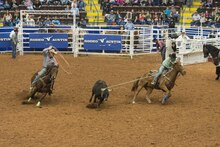
Texans also enjoy rodeo. The world's first rodeo was hosted in Pecos, Texas.[338] The annual Houston Livestock Show and Rodeo is the largest rodeo in the world. The Southwestern Exposition and Livestock Show in Fort Worth is the oldest continuously running rodeo incorporating many of the state's most historic traditions into its annual events. Dallas hosts the State Fair of Texas each year at Fair Park.[339]
Texas Motor Speedway hosts annual NASCAR Cup Series and IndyCar Series auto races since 1997. Since 2012, Austin's Circuit of the Americas plays host to a round of the Formula 1 World Championship.[340]
Education
The second president of the Republic of Texas, Mirabeau B. Lamar, is the Father of Texas Education. During his term, the state set aside three leagues in each county for public schools. An additional 50 leagues of land set aside for the support of two universities would later become the basis of the state's Permanent University Fund.[341] Lamar's actions set the foundation for a Texas-wide public school system.[342]
Between 2006 and 2007, Texas spent $7,275 per pupil, ranking it below the national average of $9,389. The pupil/teacher ratio was 14.9, below the national average of 15.3. Texas paid instructors $41,744, below the national average of $46,593. The Texas Education Agency (TEA) administers the state's public school systems. Texas has over 1,000 school districts; all districts except the Stafford Municipal School District are independent from municipal government and many cross city boundaries.[343] School districts have the power to tax their residents and to assert eminent domain over privately owned property. Due to court-mandated equitable school financing, the state has a tax redistribution system called the "Robin Hood plan" which transfers property tax revenue from wealthy school districts to poor ones.[344] The TEA has no authority over private or homeschooling activities.[345]
Students in Texas take the State of Texas Assessments of Academic Readiness (STAAR) in primary and secondary school. STAAR assess students' attainment of reading, writing, mathematics, science, and social studies skills required under Texas education standards and the No Child Left Behind Act. The test replaced the Texas Assessment of Knowledge and Skills (TAKS) test in the 2011–2012 school year.[346]
Generally prohibited in the Western world, school corporal punishment is not unusual in the more conservative, rural areas of the state,[347][348][349] with 28,569 public school students paddled at least one time,[g] according to government data for the 2011–2012 school year.[350] The rate of school corporal punishment in Texas is surpassed only by Mississippi, Alabama, and Arkansas.[350]
Higher education
.jpg)


The state's two most widely recognized flagship universities are The University of Texas at Austin and Texas A&M University, ranked as the 21st[351] and 41st[352] best universities in the nation according to 2020's latest Center for World University Rankings report, respectively. Some observers[353] also include the University of Houston and Texas Tech University as tier one flagships alongside UT Austin and A&M.[354][355] The Texas Higher Education Coordinating Board ranks the state's public universities into three distinct tiers:[356]
- National Research Universities (Tier 1)[357][358]
- Emerging Research Universities (Tier 2)[356]
- Comprehensive Universities (Tier 3)[356]
- All other public universities (25 in total)
Texas's alternative affirmative action plan, Texas House Bill 588, guarantees Texas students who graduated in the top 10 percent of their high school class automatic admission to state-funded universities. This does not apply to The University of Texas at Austin, which automatically admits Texas students who graduated in the top 6 percent of their high school class.[359] The bill encourages demographic diversity while attempting to avoid problems stemming from the Hopwood v. Texas (1996) case.[360]
Thirty-six public universities exist in Texas, of which 32 belong to one of the six state university systems.[361][362] Discovery of minerals on Permanent University Fund land, particularly oil, has helped fund the rapid growth of the state's two largest university systems: the University of Texas System and the Texas A&M System. The four other university systems: the University of Houston System, the University of North Texas System, the Texas State System, and the Texas Tech System are not funded by the Permanent University Fund.[363]
The Carnegie Foundation classifies four of Texas's universities as Tier One research institutions: The University of Texas at Austin, the Texas A&M University, the University of Houston and Texas Tech University. The University of Texas at Austin and Texas A&M University are the flagship universities of the University of Texas System and Texas A&M University System, respectively. Both were established by the Texas Constitution and hold stakes in the Permanent University Fund.[363]
The state has sought to expand the number of flagship universities by elevating some of its seven institutions designated as "emerging research universities". The two expected to emerge first are the University of Houston and Texas Tech University, likely in that order according to discussions on the House floor of the 82nd Texas Legislature.[364]
The state is home to various private institutions of higher learning—ranging from liberal arts colleges to a nationally recognized top-tier research university. Rice University in Houston is one of the leading teaching and research universities of the United States and is ranked the nation's 17th-best overall university by U.S. News & World Report.[365]
Trinity University, a private, primarily undergraduate liberal arts university in San Antonio, has ranked first among universities granting primarily bachelor's and select master's degrees in the Western United States for 20 consecutive years by U.S. News.[366] Private universities include Abilene Christian University, Austin College, Baylor University, University of Mary Hardin–Baylor, and Southwestern University.[367][368][369]
Universities in Texas host three presidential libraries: George Bush Presidential Library at Texas A&M University,[370] the Lyndon Baines Johnson Library and Museum at The University of Texas at Austin,[371][372] and the George W. Bush Presidential Library at Southern Methodist University.[373]
Healthcare
Notwithstanding the concentration of elite medical centers in the state, The Commonwealth Fund ranks the Texas healthcare system the third worst in the nation.[374] Texas ranks close to last in access to healthcare, quality of care, avoidable hospital spending, and equity.[374] In May 2006, Texas initiated the program "code red" in response to the report the state had 25.1 percent of the population without health insurance, the largest proportion in the nation.[375]
The Trust for America's Health ranked Texas 15th highest in adult obesity: 27.2 percent of the state's population is obese.[376] The 2008 Men's Health obesity survey ranked four Texas cities among the top 25 fattest cities in America: Houston ranked 6th, Dallas 7th, El Paso 8th, and Arlington 14th.[377] Texas had only one city (Austin, ranked 21st) in the top 25 "fittest cities" in America.[377] The state is ranked forty-second in the percentage of residents who engage in regular exercise according to a 2007 study.[378]
Texas has the highest maternal mortality rate in the developed world, and the rate by which Texas women died from pregnancy-related complications doubled from 2010 to 2014, to 23.8 per 100,000—a rate unmatched in any other U.S. state or economically developed country.[379] In May 2021, the state legislature passed the Texas Heartbeat Act, which banned abortion from as early as six weeks of pregnancy, except to save the life of the mother. The Act allows private citizens to sue abortion providers and anyone else who assists in an abortion, except for the woman on whom the abortion is performed.[380][381] On August 25, 2022, another law took effect that made committing abortion at any stage of pregnancy a felony punishable by life in prison.[382]
Medical research

Texas has many elite research medical centers. The state has 15 medical schools,[383] four dental schools,[384] and two optometry schools.[385] Texas has two Biosafety Level 4 (BSL-4) laboratories: one at The University of Texas Medical Branch (UTMB) in Galveston,[386] and the other at the Southwest Foundation for Biomedical Research in San Antonio—the first privately owned BSL-4 lab in the United States.[387]
The Texas Medical Center in Houston holds the world's largest concentration of research and healthcare institutions, with over 50 member institutions.[388] Texas Medical Center performs the most heart transplants in the world.[389] The University of Texas M. D. Anderson Cancer Center in Houston is a highly regarded academic institution that centers around cancer patient care, research, education and prevention.[390]
San Antonio's South Texas Medical Center facilities rank sixth in clinical medicine research impact in the United States.[391] The University of Texas Health Science Center is another highly ranked research and educational institution in San Antonio.[392][393]
Both the American Heart Association and the University of Texas Southwestern Medical Center call Dallas home.[394] The institution's medical school employs the most medical school Nobel laureates in the world.[394][395]
Transportation

The state's large size and rough terrain have historically complicated transportation. Texas has compensated by building the nation's largest highway and railway systems. The regulatory authority, the Texas Department of Transportation (TxDOT), maintains the state's highway system, regulates aviation,[396] and public transportation systems.[397]
The state is an important transportation hub. From the Dallas/Fort Worth area, trucks can reach 93 percent of the nation's population within 48 hours, and 37 percent within 24 hours.[398] Texas has 33 foreign trade zones (FTZ), the most in the nation.[399] In 2004, a combined total of $298 billion of goods passed through Texas FTZs.[399]
Highways

The first Texas freeway was the Gulf Freeway opened in 1948 in Houston.[400] As of 2005, 79,535 miles (127,999 km) of public highway crisscrossed Texas (up from 71,000 miles or 114,000 km in 1984).[401] To fund recent growth in the state highways, Texas has 17 toll roads with several additional tollways proposed.[402] In Central Texas, the southern section of the State Highway 130 toll road has a speed limit of 85 miles per hour (137 km/h), the highest in the nation.[403] All federal and state highways in Texas are paved.
Airports


Texas has 730 airports, second-most of any state in the nation. Largest in Texas by size and passengers served, Dallas/Fort Worth International Airport (DFW) is the second-largest by area in the United States, and fourth in the world with 18,076 acres (73.15 km2).[404] In traffic, DFW airport is the busiest in the state, the fourth busiest in the United States,[405] and sixth worldwide.[406] Southwest Airlines, headquartered in Dallas, has its operations at Dallas Love Field.[407] American Airlines Group's American / American Eagle, the world's largest airline in total passengers-miles transported and passenger fleet size,[408] uses DFW as its largest and main hub.
Texas's second-largest air facility is Houston's George Bush Intercontinental Airport (IAH). It serves as the largest hub for United Airlines, the world's third-largest airline, by passenger-miles flown.[409][h] IAH offers service to the most Mexican destinations of any U.S. airport.[410][411] The next five largest airports in the state all serve more than three million passengers annually; they include Austin-Bergstrom International Airport, William P. Hobby Airport, San Antonio International Airport, Dallas Love Field and El Paso International Airport. The smallest airport in the state to be designated an international airport is Del Rio International Airport.
Ports

Around 1,150 seaports dot Texas's coast with over 1,000 miles (1,600 km) of channels.[412] Ports employ nearly one-million people and handle an average of 317 million metric tons.[413] Texas ports connect with the rest of the U.S. Atlantic seaboard with the Gulf section of the Intracoastal Waterway.[412] The Port of Houston today is the busiest port in the United States in foreign tonnage, second in overall tonnage, and tenth worldwide in tonnage.[414] The Houston Ship Channel spans 530 feet (160 m) wide by 45 feet (14 m) deep by 50 miles (80 km) long.[415]
Railroads


Part of the state's tradition of cowboys is derived from the massive cattle drives which its ranchers organized in the nineteenth century to drive livestock to railroads and markets.
The first railroad to operate in Texas was the Buffalo Bayou, Brazos and Colorado Railway, opening in August 1853.[416] The first railroad to enter Texas from the north, completed in 1872, was the Missouri–Kansas–Texas Railroad.[417] With increasing railroad access, the ranchers did not have to take their livestock up to the Midwest and shipped beef out from Texas. This caused a decline in the economies of the cow towns.[418]
Since 1911, Texas has led the nation in length of railroad miles within the state. Texas railway length peaked in 1932 at 17,078 miles (27,484 km), but declined to 14,006 miles (22,540 km) by 2000. While the Railroad Commission of Texas originally regulated state railroads, in 2005 the state reassigned these duties to TxDOT.[419]
In the Dallas–Fort Worth area, three public transit agencies provide rail service: Dallas Area Rapid Transit (DART), Denton County Transportation Authority (DCTA), and Trinity Metro. DART began operating the first light rail system in the Southwest United States in 1996.[420] The Trinity Railway Express (TRE) commuter rail service, which connects Fort Worth and Dallas, is provided by Trinity Metro and DART.[421] Trinity Metro also operates the TEXRail commuter rail line, connecting downtown Fort Worth and Northeast Tarrant County to DFW Airport.[422] The A-train commuter rail line, operated by DCTA, acts as an extension of the DART Green line into Denton County.[423] In the Austin area, Capital Metropolitan Transportation Authority operates a commuter rail service known as Capital MetroRail to the northwestern suburbs. The Metropolitan Transit Authority of Harris County, Texas (METRO) operates light rail lines called METRORail in the Houston area.[424]
Amtrak provides Texas with limited intercity passenger rail service. Three scheduled routes serve the state: the daily Texas Eagle (Chicago–San Antonio); the tri-weekly Sunset Limited (New Orleans–Los Angeles), with stops in Texas; and the daily Heartland Flyer (Fort Worth–Oklahoma City). Texas may get one of the nation's first high-speed rail line. Plans for a privately funded high-speed rail line between Dallas and Houston have been planned by the Texas Central Railway company.[425]
Government and politics
The current Texas Constitution was adopted in 1876. Like many states, it explicitly provides for a separation of powers. The state's Bill of Rights is much larger than its federal counterpart, and has provisions unique to Texas.[426]
State government

Texas has a plural executive branch system limiting the power of the governor, which is a weak executive compared to some other states. Except for the secretary of state, voters elect executive officers independently; candidates are directly answerable to the public, not the governor.[427] This election system has led to some executive branches split between parties and reduced the ability of the governor to carry out a program. When Republican president George W. Bush served as Texas's governor, the state had a Democratic lieutenant governor, Bob Bullock. The executive branch positions consist of the governor, lieutenant governor, comptroller of public accounts, land commissioner, attorney general, agriculture commissioner, the three-member Texas Railroad Commission, the State Board of Education, and the secretary of state.[427]
The bicameral Texas Legislature consists of the House of Representatives, with 150 members, and a Senate, with 31 members. The Speaker of the House leads the House, and the lieutenant governor, the Senate.[428] The Legislature meets in regular session biennially for just over a hundred days, but the governor can call for special sessions as often as desired (notably, the Legislature cannot call itself into session).[429] The state's fiscal year begins September 1.[430]
The judiciary of Texas is among the most complex in the United States, with many layers and overlapping jurisdictions. Texas has two courts of last resort: the Texas Supreme Court, for civil cases, and the Texas Court of Criminal Appeals. Except for some municipal benches, partisan elections select judges at all levels of the judiciary; the governor fills vacancies by appointment.[431] Texas is notable for its use of capital punishment, having led the country in executions since capital punishment was reinstated in the Gregg v. Georgia case.[432]
The Texas Ranger Division of the Texas Department of Public Safety is a law enforcement agency with statewide jurisdiction. Over the years, the Texas Rangers have investigated crimes ranging from murder to political corruption. They have acted as riot police and as detectives, protected the Texas governor, tracked down fugitives, and functioned as a paramilitary force. The Texas Rangers were unofficially created by Stephen F. Austin in 1823 and formally constituted in 1835. The Rangers were integral to several important events of Texas history and some of the best-known criminal cases in the history of the Old West.[433]
The Texas constitution defines the responsibilities of county governments, which serve as agents of the state. Commissioners court and court judges are elected to serve as the administrative arm. Most cities in the state, those over 5,000 in population, have home-rule governments. The vast majority of these have charters for council-manager forms of government, by which voters elect council members, who hire a professional city manager as an operating officer.[434]
Politics


The Democratic Party dominated Texas politics from the turn of the 20th century, imposing racial segregation and white supremacy. It held power until after passage in the mid-1960s of national civil rights legislation enforcing constitutional rights of all citizens.[435][436]
The state's conservative White voters began to support Republican presidential candidates by the mid-20th century. After this period, they supported Republicans for local and state offices as well, and most Whites became Republican Party members.[437] The party also attracted some minorities, but many have continued to vote for Democratic candidates. The shift to the Republican Party is much-attributed to the fact the Democratic Party became increasingly liberal during the 20th century, and thus increasingly out-of-touch with the average Texas voter.[438] As Texas was always a conservative state, voters switched to the Republicans, which now more closely reflected their beliefs.[438][439] Commentators have also attributed the shift to Republican political consultant Karl Rove, who managed numerous political campaigns in Texas in the 1980s and 1990s.[439] Other stated reasons included court-ordered redistricting and the demographic shift in relation to the Sun Belt that favored the Republican Party and conservatism.[129]
The 2003 Texas redistricting of Congressional districts led by Republican Tom DeLay, was called by The New York Times "an extreme case of partisan gerrymandering".[440] A group of Democratic legislators, the "Texas Eleven", fled the state in a quorum-busting effort to prevent the legislature from acting, but was unsuccessful.[441] The state had already redistricted following the 2000 census. Despite these efforts, the legislature passed a map heavily in favor of Republicans, based on 2000 data and ignoring the estimated nearly one million new residents in the state since then. Career attorneys and analysts at the Department of Justice objected to the plan as diluting the votes of African American and Hispanic voters, but political appointees overrode them and approved it.[440] Legal challenges to the redistricting reached the national Supreme Court in the case League of United Latin American Citizens v. Perry (2006), but the court ruled in favor of the state (and Republicans).[442]
In the 2014 Texas elections, the Tea Party movement made large gains, with numerous Tea Party favorites being elected into office, including Dan Patrick as lieutenant governor,[443][444] Ken Paxton as attorney general,[443][445] in addition to numerous other candidates[445] including conservative Republican Greg Abbott as governor.[446]
Texas voters lean toward fiscal conservatism, while enjoying the benefits of huge federal investment in the state in military and other facilities achieved by the power of the Solid South in the 20th century. They also tend to have socially conservative values.[263][447]
Since 1980, most Texas voters have supported Republican presidential candidates. Austin, Dallas, Houston, San Antonio, and El Paso consistently lean Democratic in both local and statewide elections.[131] Residents of counties along the Rio Grande closer to the Mexico–United States border, where there are many Latino residents, generally vote for Democratic Party candidates, while most other rural and suburban areas of Texas have shifted to voting for Republican Party candidates.[448][449]
As of the midterm elections of 2022, a large majority of the members of Texas's U.S. House delegation are Republican, along with both U.S. Senators. In the 118th United States Congress, of the 38 Congressional districts in Texas, 25 are held by Republicans and 13 by Democrats. Texas's Senators are John Cornyn and Ted Cruz. Since 1994, Texans have not elected a Democrat to a statewide office. The state's Democratic voters are made up primarily by liberal and minority groups in Austin, Beaumont, Dallas, El Paso, Houston, and San Antonio as well as minority voters in East and South Texas.[450][451][452] According to a study by the Cato Institute, a libertarian think tank, Texas ranks last in personal freedom among the states, by factors including incarceration rates, cannabis laws, civil asset forfeiture policies, educational freedom, gambling laws, marriage freedom, and travel freedom.[453][454]
Criminal law
Texas has a reputation of very harsh criminal punishment for criminal offenses. It is one of the 32 states that practice capital punishment, and since the US Supreme Court allowed capital punishment to resume in 1976, 40% of all U.S. executions have taken place in Texas.[455] As of 2018, Texas had the 8th highest incarceration rate in the U.S.[456] Texas also has strong right of self-defense and self defense laws, allowing citizens to use lethal force to defend themselves, their families, or their property.[457]
See also


Notes
- ^ Elevation adjusted to North American Vertical Datum of 1988.
- ^ In Peninsular Spanish, the spelling variant Tejas is also used alongside Texas. According to the Diccionario panhispánico de dudas by the Royal Spanish Academy and the Association of Academies of the Spanish Language, the spelling version with ⟨j⟩ aligns with modern-day orthographic conventions and is correct; however, the spelling with ⟨x⟩ is recommended, as it is the one that is used in Mexican Spanish.[9] See Spanish orthography § History.
- ^ Cabeza de Vaca wrote, "They went about with a firebrand, setting fire to the plains and timber so as to drive off the mosquitos, and also to get lizards and similar things which they eat, to come out of the soil. In the same manner they kill deer, encircling them with fires, and they do it also to deprive the animals of pasture, compelling them to go for food where the Indians want."[45]
- ^ Vázquez de Coronado wrote, "Two kinds of people travel around these plains with the cows; one is called Querechos and the others Teyas; they are very well built, and painted, and are enemies of each other. They have no other settlement or location than comes from traveling around with the cows. They kill all of these they wish and tan the hides, with which they clothe themselves and make their tents, and they eat the flesh, sometimes even raw, and they also even drink the blood when thirsty. The tents they make are like field tents, and they set them up over poles they have made for this purpose, which come together and are tied at the top, and when they go from one place to another they carry them on some dogs they have, of which they have many, and they load them with the tents and poles and other things, for the country is so level, as I said, that they can make use of these, because they carry the poles dragging along on the ground. The sun is what they worship most."[47]
- ^ Persons of Hispanic or Latino origin are not distinguished between total and partial ancestry.
- ^ Second to California.
- ^ This figure refers to only the number of students paddled, regardless of whether a student was spanked multiple times in a year, and does not refer to the number of instances of corporal punishment, which would be substantially higher.
- ^ Based on the industry-standard measure of revenue passenger-kilometers/miles flown.
References
- ^ a b c d e Plocheck, Robert (November 20, 2017). "Facts". Texas Almanac (2010–2011 ed.). Archived from the original on February 28, 2011.
- ^ a b "Environment". Texas Almanac. 2008. Retrieved June 28, 2020.
- ^ "El Capitan". NGS Data Sheet. National Geodetic Survey, National Oceanic and Atmospheric Administration, United States Department of Commerce. Retrieved October 20, 2011.
- ^ a b "Elevations and Distances in the United States". United States Geological Survey. 2001. Archived from the original on July 22, 2012. Retrieved October 24, 2011.
- ^ a b "Historical Population Change Data (1910–2020)". Census.gov. United States Census Bureau. Archived from the original on April 29, 2021. Retrieved May 1, 2021.
- ^ "Texas". U.S. Census Bureau. 2021. Retrieved May 17, 2023.
- ^ "Languages Spoken at Home". United States Census Bureau. Retrieved June 5, 2020.
- ^ Wells, John C. (1982). Accents of English. Vol. 3: Beyond the British Isles (pp. i–xx, 467–674). Cambridge University Press. p. 551. doi:10.1017/CBO9780511611766. ISBN 0-52128541-0.
- ^ "Texas" in Diccionario panhispánico de dudas by Royal Spanish Academy and Association of Academies of the Spanish Language, Madrid: Santillana. 2005. ISBN 978-8-429-40623-8.
- ^ Carlson, Kara. More than 30 million people now call Texas home as state leads US population gains, Austin American-Statesman, December 23, 2022.
- ^ QuickFacts, Population Estimates, U.S. Census Bureau, July 1, 2023.
- ^ Press Release. Growth in U.S. Population Shows Early Indication of Recovery Amid COVID-19 Pandemic, U.S. Census Bureau, December 22, 2022.
- ^ "The State of Texas". Netstate.com. Retrieved April 11, 2010.
- ^ "Twenty-ninth Congress: Resolutions" (PDF). legisworks.org. 1845. Archived from the original (PDF) on May 25, 2017. Retrieved May 16, 2017.
- ^ Ramos, Mary G.; Reavis, Dick J. (2004). Texas. Fodor's Travel Publications. p. 125. ISBN 978-0-676-90502-1.
- ^ a b "Texas leads nation as home to the most Fortune 500 companies". FOX 7 Austin. May 24, 2022. Retrieved October 31, 2022.
- ^ a b Miranda, Cynthia (May 25, 2022). "Texas houses the most Fortune 500 companies in the nation". KETK.com. Retrieved October 31, 2022.
- ^ Sansom, Andrew (2008). Water in Texas: An Introduction. University of Texas Press. p. 25. ISBN 978-0-292-71809-8.
- ^ José Arlegui, Chronica de la provincia de N.S.P.S. Francisco de Zacatecas Front Cover (1737), p. 53.
- ^ "Texas". Online Etymology Dictionary. Douglas Harper. Retrieved February 25, 2007.
- ^ Fry, Phillip L. (March 7, 2016) [July 15, 2010]. "Texas, Origin of Name". Handbook of Texas (online ed.). Texas State Historical Association.
- ^ Davis, Lucile (2003). The Caddo of Texas. Rosen Publishing. p. 5. ISBN 9780823964352.
- ^ a b Teja, Jesús de la (June 15, 2010). "New Philippines". Handbook of Texas (online ed.). Texas State Historical Association.
- ^ Oakah L. Jones, Los Paisanos: Spanish Settlers on the Northern Frontier of New Spain, University of Oklahoma Press (1996), p. 277, citing a document dated November 5, 1730.
- ^ Joseph de Laporte, El viagero universal: Ó, Noticia del mundo antiguo y nuevo vol. 27 (1799), p. 114.
- ^ "Texas. Grafía recomendada para el nombre de este estado norteamericano. Su pronunciación correcta es [téjas], no [téksas]. Se recomienda escribir asimismo con x el gentilicio correspondiente: texano. Son también válidas las grafías con j (Tejas, tejano), de uso mayoritario en España." Diccionario panhispánico de dudas, Real Academia Española (2005), s.v. Texas.
- ^ a b Charles Dimitry, "American Geographical Nomenclature", Appletons' Journal 15 (1876), 758f.
- ^ Richardson et al. 2021, p. 9.
- ^ a b c d Carter, Cecile Elkins (1995). Caddo Indians where we come from. University of Oklahoma Press. ISBN 0-585-17049-5. OCLC 1253386080.
- ^ "The Caddo Nation". University of Texas Press. 1993. doi:10.7560/711501. ISBN 978-0-292-79978-3.
- ^ Aten, Lawrence E. (1983). Indians of the upper Texas coast. Academic Pr. ISBN 0-12-065740-6. OCLC 254092448.
- ^ Richardson et al. 2021, p. 10.
- ^ Richardson et al. 2021, p. 12.
- ^ Klos, George (June 15, 2010). "Indians". Handbook of Texas (online ed.). Texas State Historical Association.
- ^ Barr, Juliana (November 2009). Peace Came in the Form of a Woman : Indians and Spaniards in the Texas Borderlands. University of North Carolina Press. ISBN 978-1-4696-0470-1. OCLC 1148108904.
- ^ Galán, Francis X. (2020). Los Adaes : the first capital of Spanish Texas. Texas A&M University Press. ISBN 978-1-62349-878-8. OCLC 1128731300.
- ^ a b c Glover, William B. "A History of the Caddo Indians". Reprinted from 'The Louisiana Historical Quarterly'; Vol. 18, No. 4. October 1935
- ^ Swanton, John R. Indians of the Southeastern United States (Washington: United States Government Printing Office, 1946) p. 139
- ^ a b Richardson, Rupert N.; Anderson, Adrian; Wintz, Cary D.; Wallace, Ernest (2005). Texas: the Lone Star State (9th ed.). Prentice Hall. pp. 10–16. ISBN 978-0-1318-3550-4.
- ^ Gwynne, S. C. (2011). Empire of the Summer Moon. Constable & Robinson. ISBN 978-1-84901-820-3. OCLC 968100096.
- ^ Chipman (1992), p. 243; Weber (1992), p. 34
- ^ Chipman, Donald E. (August 3, 2017) [June 12, 2010]. "Álvar Núñez Cabeza de Vaca". Handbook of Texas (online ed.). Texas State Historical Association.
- ^ Chipman, Donald E. (January 23, 2017) [June 15, 2010]. "Spanish Texas". Handbook of Texas (online ed.). Texas State Historical Association.
- ^ "The Journey of Alvar Nuńez Cabeza de Vaca". American Journeys. Wisconsin Historical Society. Archived from the original on October 5, 2012.
- ^ Davidson, James West; Lytle, Mark H (2010). "Chapter 1". After the Fact: The Art of Historical Detection. Vol. 1 (6th ed.). McGraw Hill. p. 7. ISBN 978-0-0733-8548-8.
- ^ Davidson, James West; Lytle, Mark H (2010). "Chapter 1". After the Fact: The Art of Historical Detection. Vol. 1 (6th ed.). McGraw Hill. p. 7. ISBN 978-0-0733-8548-8.
- ^ Winship, George Parker, ed. (1904). The Journey of Coronado, 1540–1542. A.S. Barnes & Company. pp. 210–211.
- ^ Winship, George Parker, ed. (1904). The Journey of Coronado, 1540–1542. A.S. Barnes & Company. pp. 210–211.
- ^ Hudson, Charles M. (2018). Knights of Spain, warriors of the sun : Hernando De Soto and the South's ancient chiefdoms. University of Georgia Press. ISBN 978-0-8203-5160-5. OCLC 981166517.
- ^ Clayton, Lawrence A.; Knight, Vernon J.; Moore, Edward C. (1995). The De Soto chronicles : the expedition of Hernando de Soto to North America in 1539-1543. University of Alabama Press. ISBN 0-585-36805-8. OCLC 47010055.
- ^ Weber (1992), p. 149.
- ^ Chipman (1992), p. 83.
- ^ Joutel, Henri (1998). The La Salle expedition to Texas : the journal of Henri Joutel, 1684-1687. Texas State Historical Association. ISBN 0-87611-165-7. OCLC 962854705.
- ^ Chipman (1992), p. 89.
- ^ Weber (1992), p. 155.
- ^ Chipman (1992), pp. 111–112; Weber (1992), p. 160
- ^ Weber (1992), p. 163.
- ^ Bolton, Herbert Eugene (1915). Texas in the Middle 18th Century. University of California Press. p. facing p. 382.
- ^ Chipman (1992), p. 205.
- ^ Weber (1992), p. 193.
- ^ Weber (1992), p. 189.
- ^ Weddle (1995), p. 164; Chipman (1992), p. 200
- ^ Weddle (1995), p. 163.
- ^ Chipman (1992), p. 202.
- ^ Weber (1992), pp. 291–299.
- ^ Davis (2006), p. 46.
- ^ "Most of the Filipinos in Texas are comparatively recent arrivals. Strong economic and political ties with the Spanish empire from the 16th to the 19th centuries brought few known individuals to the Americas, but United States control in the early 20th century was responsible for Filipino settlement in every metropolitan area in the state. Considering the Spanish trade with the Philippines—the Manila galleons operated between Acapulco and Manila from 1565 to 1815—travelers from the islands may have been in Mexico after the mid-16th century" (PDF). Texascultures.housing.utexas.edu. Retrieved April 17, 2021.
- ^ Hinton, Matthew (October 23, 2019). "From Manila to the Marigny: How Philippine pioneers left a mark at the 'end of world' in New Orleans". Very Local New Orleans.
- ^ Weber (1992), p. 300.
- ^ Manchaca (2001), p. 162.
- ^ Manchaca (2001), p. 164.
- ^ Manchaca (2001), p. 198.
- ^ Edmondson (2000), p. 75.
- ^ Manchaca (2001), p. 172, 201.
- ^ Edmondson (2000), p. 78.
- ^ Manchaca (2001), p. 200.
- ^ Davis (2006), p. 77.
- ^ Davis (2006), p. 85.
- ^ Davis (2006), pp. 86–89.
- ^ Davis (2006), p. 92.
- ^ Steen, Ralph W. (June 12, 2010). "Convention of 1833". Handbook of Texas (online ed.). Texas State Historical Association.
- ^ Huson, Hobart (1974). Captain Phillip Dimmitt's Commandancy of Goliad, 1835–1836: An Episode of the Mexican Federalist War in Texas, Usually Referred to as the Texian Revolution. Von Boeckmann-Jones Co. p. 4.
- ^ Hardin (1994), p. 12.
- ^ Winders (2004), p. 72.
- ^ Winders (2004), pp. 90, 92Hardin (1994), p. 109
- ^ Hardin (1994), p. 102.
- ^ Roell, Craig H. (July 12, 2016) [June 12, 2010]. "Coleto, Battle of". Handbook of Texas (online ed.). Texas State Historical Association.
- ^ a b Todish, Todish & Spring (1998), p. 68.
- ^ Roberts and Olson (2001), p. 144.
- ^ Todish, Todish & Spring (1998), p. 69.
- ^ Todish, Todish & Spring (1998), p. 70.
- ^ "Tarlton Law Library: Constitution of the Republic of Texas (1836): General Provisions". tarlton.law.utexas.edu. Retrieved December 28, 2020.
No free person of African descent, either in whole or in part, shall be permitted to reside permanently in the Republic, without the consent of Congress, and the importation or admission of Africans or negroes into this Republic, excepting from the United States of America, is forever prohibited, and declared to be piracy.
- ^ "The Archives War". Texas Treasures- The Republic. The Texas State Library and Archives Commission. November 2, 2005. Archived from the original on January 7, 2009. Retrieved January 3, 2009.
- ^ a b Andrew J. Torget (2015). Seeds of Empire: Cotton, Slavery, and the Transformation of the Texas Borderlands, 1800–1850. The University of North Carolina Press. ISBN 978-1469624242.
- ^ This had also been their policy toward neighboring tribes before the arrival of the settlers. Gwinnett, S.C. (2010). Empire of the Summer Moon: Quanah Parker and the Rise and Fall of the Comanches, the Most Powerful Indian Tribe in American History. Simon and Schuster. ISBN 978-1-4165-9106-1.
- ^ Calvert, Robert A.; León, Arnoldo De; Cantrell, Gregg (2002). The History of Texas. Harlan Davidson. ISBN 978-0-88295-966-5.
- ^ Buescher, John. "Senatorial Division", Teachinghistory.org, accessed August 21, 2011. Archived July 11, 2011, at the Wayback Machine
- ^ a b Neu, C. T. (December 2, 2015) [June 9, 2010]. "Annexation". Handbook of Texas (online ed.). Texas State Historical Association.
- ^ a b Bauer, K. Jack (March 28, 2016) [June 15, 2010]. "Mexican War". Handbook of Texas (online ed.). Texas State Historical Association.
- ^ a b c Griffin, Roger A. (March 21, 2016) [June 12, 2010]. "Compromise of 1850". Handbook of Texas (online ed.). Texas State Historical Association.
- ^ Britton, Karen Gerhardt; Elliott, Fred C.; Miller, E. A. (June 12, 2010). "Cotton Culture". Handbook of Texas (online ed.). Texas State Historical Association.
- ^ Schulte, Susan (December 9, 2010). "Visualizing Slavery: A Map of Slavery Interactive Feature". The New York Times.
- ^ a b Dulaney, W. Marvin (July 25, 2016) [June 9, 2010]. "African Americans". Handbook of Texas (online ed.). Texas State Historical Association.
- ^ Buenger, Walter L. (March 8, 2011) [June 15, 2010]. "Secession Convention". Handbook of Texas (online ed.). Texas State Historical Association.
- ^ Kreneck, Thomas H. (March 30, 2017) [June 15, 2010]. "Houston, Samuel". Handbook of Texas (online ed.). Texas State Historical Association.
- ^ a b c Wooster, Ralph A. (January 30, 2017) [June 12, 2010]. "Civil War". Handbook of Texas (online ed.). Texas State Historical Association.
- ^ Federal Writers' Project (December 1997). Texas, A Guide to the Lone Star State: Brownsville. Native American Books Distributor. p. 206. ISBN 978-0-403-02192-5.
- ^ Hunt, Jeffrey William (April 20, 2021) [1952]. "Palmito Ranch, Battle of". Handbook of Texas (online ed.). Texas State Historical Association. Archived from the original on April 10, 2023.
- ^ Marvel, William (June 12, 2006). "Battle of Palmetto Ranch: American Civil War's Final Battle". HistoryNet. Archived from the original on January 22, 2021. Retrieved December 28, 2020.
- ^ "Historical Barriers to Voting". Texas Politics. University of Texas. Archived from the original on April 2, 2008. Retrieved October 13, 2008.
- ^ Acosta, Teresa Palomo (October 6, 2017) [June 15, 2010]. "Juneteenth". Handbook of Texas (online ed.). Texas State Historical Association.
- ^ Johnson, Andrew (August 20, 1866). Proclamation Declaring the Insurrection at an End. American Historical Documents. President of the United States. Retrieved April 28, 2008.
- ^ Moneyhon, Carl H. (January 30, 2017) [June 15, 2010]. "Restoration". Handbook of Texas (online ed.). Texas State Historical Association.
- ^ Pettit, Gwen. "Between the Creeks" (PDF). texashistory.unt.edu. Retrieved December 28, 2020.
The Southern states, especially the hills of Tennessee and Alabama, were impoverished; war tensions still split neighborhoods. Soon, empty houses had crude signs that stated that the former inhabitants had "Gone to Texas." Church records, also, had the phrase, "Gone to Texas" by numerous names on their roles. So many families left Maury County, Tenn., to settle in eastern Collin County, just across East Fork, that several communities, such as Culleoka, have names directly from south Maury County. That group joined relatives that had come here in the 1850s. Most new immigrants had some link to Collin County, which brought them here. They stayed with relatives and friends until they could find a place to settle. Landowners recruited farmers from the old states by persuading relatives and former neighbors to come. However, numerous families, in the pioneer tradition, loaded their children and belongings in a wagon and headed toward the unknown west. Clarksville, Bonham and Dallas newspapers reported how many wagons passed through each day and how many were camped on the "jockey yards" waiting to find a place to settle. Some of these had sold farms and had money to buy land, but most of these immigrants became tenant farmers and worked on shares.
- ^ Maxwell, Robert S. (February 15, 2012) [1976]. "Lumber Industry". Handbook of Texas. TSHA. Retrieved December 28, 2020.
But relatively, the industry's status is far below its dominant position at the beginning of the twentieth century. Then it was the state's largest manufacturing enterprise, first among Texas industries in generating income, and the largest employer of labor in the Lone Star State.
- ^ a b Blake, Eric S.; Rappaport, Edward N.; Landsea, Christopher W. (April 15, 2007). "The Deadliest, Costliest, and Most Intense United States Tropical Cyclones From 1851 to 2006" (PDF). National Weather Service: National Hurricane Center. Archived (PDF) from the original on December 17, 2023.
- ^ Wooster, Robert; Sanders, Christine Moor (April 2, 2019) [June 15, 2010]. "Spindletop Oilfield". Handbook of Texas (online ed.). Texas State Historical Association.
- ^ Olien, Roger M. (August 19, 2016) [June 15, 2010]. "Oil and Gas Industry". Handbook of Texas (online ed.). Texas State Historical Association.
- ^ "Nixon v. Condon. Disfranchisement of the Negro in Texas". The Yale Law Journal. 41 (8): 1212–1221. June 1932. doi:10.2307/791091. JSTOR 791091.
- ^ "Texas Politics: Historical Barriers to Voting". University of Texas at Austin. 2006. Archived from the original on April 2, 2008.
- ^ Alwyn, Barr (June 15, 2010). "Socialist Party". Handbook of Texas (online ed.). Texas State Historical Association.
- ^ "World War I and the Suppression of Dissent | Wendy McElroy". The Independent Institute. Retrieved December 28, 2020.
- ^ "'War against war': Americans for peace in World War I – National Constitution Center". National Constitution Center – constitutioncenter.org. Retrieved December 28, 2020.
Morris Hillquit sought to keep alive the ties of his Socialist Party to its comrades abroad. Senator Robert La Follette filled many a speech with praise for progressives in other countries who shared his hatred for militarism. Henry Ford chartered an ocean liner to transport himself and dozens of other activists across the Atlantic, where they lobbied neutral governments to embrace a peace plan they would press on the warring powers. These Americans, like most critics of the war elsewhere in the world, wanted to create a new global order based on cooperative relationships between nation states and their gradual disarmament. Militarism, they argued, isolated peoples behind walls of mutual fear and loathing. Until April 1917, this formidable coalition of idealists—or realists—did much to keep the nation at peace. They may even have had a majority of Americans on their side until just weeks before Congress, at Wilson's behest, voted to declare war. To prevent that from happening, peace activists pressed for a national referendum on the question, confident that "the people" would recoil from fighting and paying the bills in order to help one group of European powers conquer another.
- ^ Jillson, Cal (2011). Texas Politics: Governing the Lone Star State. Taylor & Francis. p. 11. ISBN 978-0-203-82941-7.
- ^ Lee, James Ward; Barnes, Carolyn N.; Bowman, Kent Adam (1991). 1941: Texas Goes to War. University of North Texas Press. ISBN 978-0-929398-29-7.
- ^ Fairchild, Louis (2012). They Called It the War Effort: Oral Histories from World War II Orange, Texas (second ed.). Texas A&M University Press. ISBN 978-0-87611-259-5.
- ^ Peck, Merton J.; Scherer, Frederic M. (1962). The weapons acquisition process: an economic analysis. Division of Research, Graduate School of Business Administration, Harvard University. p. 111.
- ^ Blanton, Carlos Kevin (2005). "The Campus and the Capitol: John B. Connally and the Struggle over Texas Higher Education Policy, 1950–1970". Southwestern Historical Quarterly. 108 (4): 468–497. ISSN 0038-478X.
- ^ a b c d e f g Calvert, Robert A. (January 30, 2017) [June 15, 2010]. "Texas Since World War II". Handbook of Texas (online ed.). Texas State Historical Association.
- ^ Tamir, Christine (March 25, 2021). "The Growing Diversity of Black America". Pew Research Center's Social & Demographic Trends Project.
- ^ a b "Red State, Blue Cities". City Journal. September 12, 2016. Retrieved October 9, 2020.
- ^ "Chart of the Week: The most liberal and conservative big cities". Pew Research Center. Retrieved October 9, 2020.
- ^ "Meet the Next Texans, a population boom that will change our politics". Dallas News. February 22, 2018. Retrieved October 9, 2020.
- ^ Tan, Anjelica (January 26, 2020). "Why Republicans may lose Texas". The Hill. Retrieved October 20, 2020.
- ^ Fechter, Joshua (December 28, 2018). "Texas leads in job imports but figures show a mixed bag". ExpressNews.com. Retrieved December 29, 2020.
- ^ Hethcock, Bill (December 10, 2020). "Here are the California companies that relocated to Dallas-Fort Worth in 2020". Dallas Business Journal. Retrieved December 29, 2020.
- ^ Calvey, Mark (October 11, 2018). "North Texas among the regions benefitting from 'Bay Area exodus'". Dallas Business Journal. Retrieved December 29, 2020.
- ^ "Tesla's Musk and Oracle Corp. follows 687,000 other Californians who've moved to Texas in last decade". The Seattle Times. The Dallas Morning News. December 13, 2020. Retrieved December 29, 2020.
- ^ Collman, Ashley (May 28, 2019). "These are the top 10 states that people are moving to". Business Insider. Retrieved October 9, 2020.
- ^ Méndez, María (May 8, 2019). "Where is Texas' growing population coming from?". The Texas Tribune. Retrieved October 13, 2020.
- ^ "DSHS Announces First Case of COVID-19 in Texas". dshs.texas.gov. Retrieved October 9, 2020.
- ^ "Governor Abbott Announces Phase One To Open Texas, Establishes Statewide Minimum Standard Health Protocols". gov.texas.gov. Retrieved October 9, 2020.
- ^ Rosenzweig-Ziff, Patrick Svitek and Dan (November 18, 2020). "Coronavirus cases in Texas are soaring again. But this time Gov. Greg Abbott says no lockdown is coming". The Texas Tribune. Retrieved November 20, 2020.
- ^ "Texas, Florida and South Dakota governors refuse lockdowns as coronavirus resurges". NBC News. November 18, 2020. Retrieved November 20, 2020.
- ^ Fischer, Courtney; Abrahams, Tom (November 17, 2020). "Texas among states chosen to test Pfizer COVID-19 vaccine distribution". ABC13 Houston. Retrieved February 16, 2021.
- ^ "Texas Coronavirus Map and Case Count". The New York Times. April 2020. Retrieved December 29, 2020.
- ^ "Explained: How a winter storm caused widespread blackouts in energy-rich Texas". The Indian Express. February 19, 2021. Retrieved February 20, 2021.
- ^ "Miserable winter weather is still hitting Texas and now it's spreading to the East Coast". CNN. February 18, 2021. Retrieved February 20, 2021.
- ^ "ERCOT calls for rotating outages as extreme winter weather forces generating units offline". ercot.com. Archived from the original on March 2, 2021. Retrieved February 20, 2021.
- ^ Douglas, Erin (February 18, 2021). "Texas was "seconds and minutes" away from catastrophic monthslong blackouts, officials say". The Texas Tribune. Retrieved February 20, 2021.
- ^ "Texas Republicans criticized for misleading claims that renewable energy sources caused massive outages". CNN. February 18, 2021. Retrieved February 20, 2021.
- ^ Hanson, Blake (February 18, 2021). "With half of Texas under a boil water notice, state efforts shift to emerging water crisis". FOX 4. Retrieved February 20, 2021.
- ^ "How Big is Texas Compared to Countries Around the World? Huge". Wide Open Country. May 31, 2017. Retrieved December 28, 2020.
- ^ "Tx Environmental Profiles". Archived from the original on June 3, 2008. Retrieved July 14, 2006.
- ^ a b "Physical Regions of Texas". texasalmanac.com. October 4, 2019. Retrieved December 28, 2020.
- ^ "Texas Ecoregions". Texas Parks & Wildlife Department. Retrieved December 28, 2020.
- ^ "Rivers in Texas". Tpwd.state.tx.us. November 16, 2007. Retrieved April 11, 2010.
- ^ Bybee, Hal P. (June 15, 2010). "Rivers". Handbook of Texas (online ed.). Texas State Historical Association.
- ^ "Alphabetical List of Texas Lakes". Tpwd.state.tx.us. January 28, 2010. Retrieved April 11, 2010.
- ^ Nova Lomax, John (March 3, 2015). "Is Texas Southern, Western, or Truly a Lone Star?". Texas Monthly. Retrieved September 6, 2016.
- ^ "Geology". nhnct.org. Retrieved December 28, 2020.
- ^ "Late Cretaceous and Tertiary Burial History, Central Texas" (PDF). gcags.org. 2016. Retrieved December 28, 2020.
Fault displacement decreases steadily to the north of Austin and to the west of San Antonio; Balcones faulting dies out about halfway between Waco and Dallas, and about halfway between Uvalde and Del Rio.
- ^ Muzzafar, Asif. Timing of Diapir Growth and Cap Rock Formation, Davis Hill Salt Dome, Coastal Texas. GSA Annual Meeting, November 5–8, 2001. The Geological Society of America. Archived from the original on September 7, 2008. Retrieved July 22, 2008.
- ^ "Ogallala Aquifer". North Plains Groundwater Conservation District. Archived from the original on July 4, 2008. Retrieved July 23, 2008.
- ^ "Earthquakes". Jackson School of Geosciences—University of Texas. Archived from the original on May 1, 2008. Retrieved July 23, 2008.
- ^ "Texas Wildlife Identification & Viewing Guide". Wildtexas.com. December 3, 2010. Archived from the original on May 24, 2013. Retrieved April 18, 2013.
- ^ "Texas Mammals". The Mammals of Texas—Online Edition. Natural Science Research Laboratory—Museum of Texas Tech University. Archived from the original on May 8, 2013. Retrieved April 18, 2013.
- ^ West, Mary Jane (1968). "Range Extension and Solitary nest founding in Polistes Exclamans". Psyche. 75 (2): 118–123. doi:10.1155/1968/49846.
- ^ Nacko, Scott (May 2017). Occurrence and Phenology of Polistine Wasps (Hymenoptera: Vespidae) in Southern Louisiana (MS thesis). Louisiana State University. doi:10.31390/gradschool_theses.4593. Retrieved December 28, 2020 – via LSU Digital Commons.
- ^ "Lady Bird Johnson's I-95 Landscape-Landmark Tour – Highway History – FHWA – General Highway History – Highway History – Federal Highway Administration". fhwa.dot.gov. Retrieved December 28, 2020.
- ^ "El Paso, Texas Travel Weather Averages". Weatherbase. Retrieved April 18, 2013.
- ^ "Mauriceville, Texas Travel Weather Averages". Weatherbase. Retrieved April 18, 2013.
- ^ "Weather averages Dallas-DFW Intl Arpt, Texas". usclimatedata.com. Retrieved December 28, 2020.
- ^ "History: Weather Underground". Wunderground.com. December 24, 2008. Retrieved April 11, 2010.
- ^ "Monthly Averages for Marfa, Texas". The Weather Channel. Retrieved October 15, 2008.
- ^ "Monthly Averages for Galveston, Texas". The Weather Channel. Retrieved October 15, 2008.
- ^ "Texas climate averages". Weatherbase. Retrieved November 10, 2015.
- ^ NOOA.gov Archived April 23, 2017, at the Wayback Machine National Climatic Data Center. Retrieved on October 24, 2006.
- ^ Bomar, George W. (June 15, 2010). "Weather". Handbook of Texas (online ed.). Texas State Historical Association.
- ^ Hicks, Michael; Burton, Mark (September 8, 2017). Hurricane Harvey: Preliminary Estimates of Commercial and Public Sector Damages on the Houston Metropolitan Area (PDF) (Report). Ball State University. Retrieved November 1, 2017.
- ^ Levin, Matt (June 15, 2015). "Here's how tropical storms have impacted Texas in the past 35 years". Chron. Retrieved December 28, 2020.
- ^ "Tropical Storm Allison blew through Houston 19 years ago". Abc13 Houston. June 4, 2020. Retrieved December 28, 2020.
- ^ Levin, Matt (May 29, 2015). "Tropical Storm Claudette: The 'Mother Lode' of floods". Chron. Retrieved December 28, 2020.
- ^ "Casualty". BBC News. February 1, 2019. Retrieved February 12, 2019.
- ^ "Polar vortex: What is it and how does it happen?". BBC News video. January 30, 2019. Retrieved January 31, 2019.
- ^ Department of Atmospheric Sciences (DAS) at the University of Illinois at Urbana-Champaign. "Continental Polar Air Masses". Retrieved February 21, 2021.
- ^ Tom Niziol (February 16, 2021). "The lethal atmospheric setup behind a deadly Arctic outbreak: How ingredients came together for an onslaught of bone-chilling temperatures and a barrage of storms". The Washington Post. Retrieved February 21, 2021.
- ^ a b "Rankings: Total Carbon Dioxide Emissions, 2017". U.S. Energy Information Administration. 2017. Retrieved January 14, 2020.
- ^ a b "Texas No. 1 producer of greenhouse gases". The Dallas Morning News. Associated Press. June 3, 2007. Archived from the original on September 19, 2008. Retrieved June 11, 2008.
- ^ "Living, and coughing, downwind of Texas smoke stacks". phys.org. Agence France-Presse. Retrieved January 16, 2021.
- ^ a b "100 Largest Cities by Decade". U.S. Bureau of the Census. June 15, 1998.
- ^ a b Fehrenbach, T. R. (March 30, 2017) [June 15, 2010]. "San Antonio, TX". Handbook of Texas (online ed.). Texas State Historical Association.
- ^ McComb, David G. (May 5, 2016) [June 15, 2010]. "Galveston, TX". Handbook of Texas (online ed.). Texas State Historical Association.
- ^ McComb, David G. (February 15, 2017) [June 15, 2010]. "Houston, TX". Handbook of Texas (online ed.). Texas State Historical Association.
- ^ "Table 1: Annual Estimates of the Population for Incorporated Places Over 100,000, Ranked by July 1, 2006 Population: April 1, 2000 to July 1, 2006" (CSV). 2005 Population Estimates. United States Census Bureau, Population Division. June 10, 2008. Retrieved June 10, 2008. [dead link]
- ^ Bureau, US Census. "Metropolitan and Micropolitan Statistical Areas Totals: 2010–2019". The United States Census Bureau. Retrieved December 28, 2020.
- ^ Neuman, Michael. "The Texas Urban Triangle: Framework for Future Growth". Southwest Region University Transportation Center (SWUTC). Archived from the original on July 5, 2009. Retrieved October 14, 2008.
- ^ "The World According to GaWC 2008". Globalization and World Cities Research Network. Retrieved March 1, 2009.
- ^ "Distance Houston to Dallas – Air line, driving route, midpoint". distance.to. Retrieved December 28, 2020.
- ^ a b Federal Reserve Bank of Dallas Office of Community Affairs. "Colonias FAQ's (Frequently Asked Questions)". Texas Secretary of State. Archived from the original on October 9, 2008. Retrieved October 12, 2008.
- ^ Grinberg, Emmanuella. "Impoverished border town grows from shacks into community". CNN. July 8, 2011. Retrieved on July 9, 2011.
- ^ Hellmann, Paul T. (February 14, 2006). "Georgia". Historical Gazetteer of the United States. Routledge. ISBN 978-1135948597. Retrieved February 16, 2017.
- ^ "Texas County Government" (PDF). co.jefferson.tx.us. Retrieved December 28, 2020.
- ^ "Texas county judge". Ballotpedia. Retrieved December 28, 2020.
- ^ McDonald, John V. (August 2000). An Analysis of Texas' Municipal Home Rule Charters Since 1994" (Thesis). Texas State University. Archived from the original on March 4, 2012. Retrieved October 14, 2008.
- ^ "Home Rule". centertexas.org. Retrieved December 28, 2020.
- ^ "Run for Party Nomination to Public Office". Texas Politics. University of Texas. Archived from the original on March 18, 2009. Retrieved October 12, 2008.
- ^ "County Elections – Partisan or Non-Partisan? State by State" (PDF). pinellascounty.org. February 2008. Archived from the original (PDF) on January 26, 2021. Retrieved December 28, 2020.
- ^ "Annual Estimates of the Resident Population for Incorporated Places in Texas: April 1, 2010 to July 1, 2019 (SUB-IP-EST2019-ANNRES-48)". United States Census Bureau, Population Division. May 21, 2020. Retrieved December 23, 2022.
- ^ "Census finds 4 million new Texans, enough for 2 extra US House seats, though we expected more". Dallas News. April 26, 2021. Retrieved April 27, 2021.
- ^ Ura, Alexa (April 26, 2021). "Texas will gain two seats in Congress as residents of color drive population gains". The Texas Tribune. Retrieved April 27, 2021.
- ^ "Apportionment Population, Resident Population, and Overseas Population: 2020 Census and 2010 Census" (PDF). United States Census Bureau. April 26, 2021. Retrieved April 27, 2021.
- ^ Estimates of the Population by Age, Sex, and Race/Ethnicity for July 1, 2015 for State of Texas. Texas Demographic Center, U.S. Bureau of the Census State Data Center Program (PDF), July 15, 2015, archived from the original (PDF) on May 4, 2017, retrieved June 8, 2017
- ^ "Texas: 2010" (PDF). United States Census Bureau. September 2012. Retrieved October 17, 2020.
- ^ "2020 Census Apportionment Results".
- ^ "Growth in U.S. Population Shows Early Indication of Recovery Amid COVID-19 Pandemic".
- ^ a b c d e "Immigrants in Texas" (PDF). American Immigration Council. 2017.
- ^ "State Demographics Data – TX". migrationpolicy.org. Archived from the original on October 18, 2020. Retrieved October 18, 2020.
- ^ "Profile of the Unauthorized Population – TX". migrationpolicy.org. Archived from the original on October 18, 2020. Retrieved October 18, 2020.
- ^ Hennessy-Fiske, Molly; Carcamo, Cindy (June 16, 2014). "In Texas' Rio Grande Valley, a seemingly endless surge of immigrants". Los Angeles Times.
- ^ Miroff, Nick; Partlow, Joshua (June 12, 2014). "Central American migrants overwhelm Border Patrol station in Texas". The Washington Post.
- ^ "2007-2022 PIT Counts by State".
- ^ "The 2022 Annual Homelessness Assessment Report (AHAR) to Congress" (PDF).
- ^ "P2 Hispanic or Latino, and Not Hispanic or Latino by Race". Census.gov. Retrieved July 5, 2022.
- ^ Jin, Alexa Ura and Connie Hanzhang (June 20, 2019). "Texas gained almost nine Hispanic residents for every additional white resident last year". The Texas Tribune. Retrieved October 18, 2020.
- ^ Poston, Dudley (April 30, 2019). "The U.S. white majority will soon disappear forever". Houston Chronicle. Retrieved October 18, 2020.
- ^ Aaronson, Becca (May 17, 2012). "On the Records: Texas One of Five "Minority-Majority" States". The Texas Tribune. Retrieved October 18, 2020.
- ^ "American Community Survey 2018 Demographic and Housing Estimates". data.census.gov. Retrieved October 18, 2020.
- ^ "Racial and Ethnic Diversity in the United States: 2010 Census and 2020 Census". U.S. Census Bureau. August 12, 2021. Retrieved August 12, 2021.
- ^ "Booming Texas population growth, demographic changes set stage for redistricting battle". Dallas News. August 13, 2021. Retrieved August 19, 2021.
- ^ Castillo, Juan (November 17, 2011). "Hispanics make up nearly half of all Texas births in 2010, U.S. says". Austin American-Statesman. Archived from the original on November 20, 2011. Retrieved November 20, 2011.
- ^ Jervis, Rick (February 23, 2011). "Majority of Texas' population growth is Hispanic". USA Today.
- ^ "Texas Adolescent Reproductive Health Facts". US Department of Health and Human Services. Archived from the original on August 4, 2014. Retrieved August 2, 2014.
- ^ Ura, Alexa; Kao, Jason; Astudillo, Carla; Essig, Chris (August 12, 2021). "People of color make up 95% of Texas' population growth, and cities and suburbs are booming, 2020 census shows". The Texas Tribune. Retrieved June 2, 2022.
- ^ Ura, Alexa (June 22, 2023). "Hispanics officially make up the biggest share of Texas' population, new census numbers show". The Texas Tribune. Retrieved June 22, 2023.
- ^ a b c d "Texas". Modern Language Association. Archived from the original on June 19, 2006. Retrieved August 11, 2013.
- ^ "Do You Speak American. Sea to Shining Sea. American Varieties. Texan". PBS. November 29, 2003. Retrieved August 2, 2014.
- ^ "Do You Speak American. Sea to Shining Sea. American Varieties. Texan. Drawl". PBS. Retrieved August 2, 2014.
- ^ Kirstin Squint, A Linguistic and Cultural Comparison of Haitian Creole and Louisiana Creole, postcolonial.org, Accessed March 11, 2014
- ^ "American Community Survey 2020 Languages Spoken at Home Estimates". data.census.gov. Retrieved October 18, 2020.
- ^ "American Community Survey 2021 Detailed Household Language Estimates". data.census.gov. Retrieved October 18, 2020.
- ^ Blatt, Ben (May 13, 2014). "Tagalog in California, Cherokee in Arkansas: What language does your state speak?". Data source: Census Bureau American Community Survey. Map by Ben Blatt/Slate. Retrieved June 2, 2014.
- ^ Public Religion Research Institute, "American Values Atlas (Texas)" Archived February 21, 2019, at the Wayback Machine
- ^ Storey, John W. (August 25, 2023) [February 1, 1996]. "Religion". Handbook of Texas. TSHA. Retrieved February 16, 2021.
- ^ a b c "American Values Atlas". Public Religion Research Institute. Archived from the original on February 21, 2019. Retrieved February 27, 2022.
- ^ a b c d "Religion in America: U.S. Religious Data, Demographics and Statistics: Texas". Pew Research Center's Religion & Public Life Project. Retrieved October 18, 2020.
- ^ a b c "Maps and data files for 2020". U.S. Religion Census. Retrieved March 4, 2023.
- ^ "Archdiocese of Galveston-Houston". archgh.org. Retrieved March 3, 2022.
The Archdiocese of Galveston-Houston...… serves 1.7 million-plus Catholics.… is the first and oldest diocese in Texas, established by Pope Pius IX in 1847, when Galveston was named the mother diocese of the Lone Star State.
- ^ Bethancourt, Phillip (June 16, 2017). "Rough Country: How Texas Became America's Most Powerful Bible-Belt State". The Gospel Coalition. Retrieved October 20, 2020.
- ^ "Maps and data files for 2020". U.S. Religion Census. Retrieved March 4, 2023.
- ^ "Texas Online: Muslim growth adds to Texas diversity". Texanonline.net. Archived from the original on March 26, 2012. Retrieved May 7, 2012.
- ^ "Dallas Museum Lands a Rich Trove of Islamic Art". The New York Times. February 4, 2014. Retrieved February 25, 2016.
- ^ Storey, John Woodrow; Kelley; Mary L. (2008). Twentieth-century Texas: a social and cultural history. University of North Texas Press. p. 145.
- ^ "Jewish Population in the United States by State". jewishvirtuallibrary.org. Archived from the original on October 18, 2020. Retrieved October 18, 2020.
- ^ Lindsey, William D.; Silk, Mark: Religion and public life in the southern crossroads: showdown states, Altamira Press, 2004, p. 48
- ^ "Gross Domestic Product by State, Annual 2021-Q3" (PDF). Bureau of Economic Analysis. December 23, 2022. Retrieved June 9, 2019.
- ^ "World Economic Outlook Database, October 2022". International Monetary Fund. October 11, 2022.
- ^ "Economic Geography". Texas Politics. University of Texas. Archived from the original on April 30, 2009. Retrieved October 13, 2008.
- ^ "Local Area Unemployment Statistics". Bureau of Labor Statistics. Retrieved July 3, 2020.
- ^ "Site Selection Rankings". Retrieved October 10, 2011.
- ^ Scott, Walter (May 2, 2010). "Personality Parade". Parade Magazine. p. 2.
- ^ "Texas has an eye-popping number of millionaire households". CultureMap Dallas. February 19, 2018. Retrieved April 27, 2021.
- ^ a b "Texas Political Culture—Introduction". Texas Politics. University of Texas. Archived from the original on December 20, 2008. Retrieved May 29, 2008.
- ^ a b c d "Texas". Research Areas. The Tax Foundation. 2010. Archived from the original on October 23, 2008. Retrieved October 15, 2010.
- ^ "State Individual Income Taxes". Federation of Tax Administrators. Archived from the original on October 3, 2008. Retrieved October 12, 2008.
- ^ "Why does Texas (Taxus) have the highest property taxes and 3rd highest sales tax?". Alltaxtips.com. May 9, 2011. Archived from the original on July 7, 2011. Retrieved August 15, 2011.
- ^ "FAQ: Texas Sales Tax". Window.state.tx.us. Retrieved January 10, 2011.
- ^ Story, Louise (December 1, 2012). "Lines Blur as Texas Gives Industries a Bonanza". The New York Times.
- ^ "United States of Subsidies, Texas". The New York Times. December 1, 2012.
- ^ a b c d "The Texas Economy". netstate.com. June 5, 2007. Retrieved April 29, 2008.
- ^ a b Electronic Municipal Market Access (2013). "Appendix A" (PDF). The State of Texas. Municipal Securities Rulemaking Board (MSRB). Retrieved October 23, 2016.
- ^ Carmack, Liz (June 21, 2013). "The Legacy of 'King Cotton'". County. Texas Association of Counties. Archived from the original on July 23, 2015. Retrieved July 23, 2015.
- ^ "Crop Production: 2014 Summary" (PDF). United States Department of Agriculture. pp. 48–49. Retrieved July 23, 2015.
- ^ Marsh, Wendell (August 5, 2011). "No relief in sight for Texas heat and drought". Reuters. Archived from the original on March 8, 2013. Retrieved January 13, 2013.
- ^ Ramos, Mary G. (November 29, 2017). "Oil and Texas: A Cultural History". Texas Almanac 2000–2001. The Texas State Historical Association. Retrieved July 3, 2018.
- ^ Alexander Kent (July 28, 2014). "The 10 Most Oil-Rich States". 24/7 Wall Street. Retrieved August 5, 2014.
- ^ Prindle, David F. (June 15, 2010). "Railroad Commission". Handbook of Texas (online ed.). Texas State Historical Association.
- ^ a b c d e f g "Petroleum Profile: Texas". Energy Information Administration. Archived from the original on February 4, 2011. Retrieved December 13, 2008.
- ^ a b c "Texas Profile". eia.gov. Retrieved February 14, 2023.
- ^ "Texas Monthly Oil & Gas Production". rrc.texas.gov.
- ^ "Contact Us". ConocoPhillips. Retrieved December 28, 2020.
- ^ "Contact us directory". ExxonMobil. Retrieved December 28, 2020.
- ^ "Corporate Officers – Halliburton". halliburton.com. Retrieved December 28, 2020.
- ^ "Contact Us". Marathon Oil. Retrieved December 28, 2020.
- ^ "Contact Us". oxy.com. Retrieved December 28, 2020.
- ^ "Tesoro Headquarters Building I, San Antonio". emporis.com. Retrieved December 28, 2020.
- ^ "Contact Us". Valero. Retrieved December 28, 2020.
- ^ "Western Refining". dnb.com. Retrieved December 28, 2020.
- ^ "Texas State Energy Profile: Electricity". U.S. Energy Information Administration. Retrieved July 23, 2015.
Texas produces more electricity than any other state, generating almost twice as much as the next largest generating state.
- ^ "Electricity Data Browser: Net generation from electricity plants for all fuels, annual". Energy Information Administration.
- ^ Souder, Elizabeth (January 2008). "Texas leads nation in wind power capacity". The Dallas Morning News. Archived from the original on December 2, 2010. Retrieved January 19, 2008.
- ^ Clark, Stacy (December 6, 2017). "Hold Onto Your Bonnets! Breezes and Sunshine to Power Georgetown, TX". Huffington Post.
- ^ O'Grady, Eileen (October 1, 2009). "E.ON completes world's largest wind farm in Texas". Reuters. Retrieved August 26, 2010.
- ^ Kanellos, Michael. "Dell shifts base back to Round Rock". CNET. Retrieved December 28, 2020.
- ^ Clarke, Gavin. "Borland bails out of California, moves HQ to Austin, TX". theregister.com. Retrieved December 28, 2020.
- ^ "Websense gets $4.5M to move to Texas". The San Diego Union-Tribune. February 6, 2014. Retrieved December 28, 2020.
- ^ "Indeed opens new North Austin office, 1,000 new jobs planned". kvue.com. March 4, 2016. Retrieved December 28, 2020.
- ^ McKellop, Mario (May 26, 2020). "Texas Instruments starts construction on Dallas plant". The Burn-In. Retrieved December 28, 2020.
- ^ "Dell sells Perot Systems IT services division to Dallas firm". bizjournals.com. Retrieved December 28, 2020.
- ^ "Rackspace to Move into Former Texas Shopping Mall … Again". Data Center Knowledge. July 21, 2014. Retrieved December 28, 2020.
- ^ "AT&T Making a Move (Published 2008)". The New York Times. Associated Press. June 30, 2008. ISSN 0362-4331. Retrieved December 28, 2020.
- ^ "AT&T to move headquarters to Dallas". NBC News. June 27, 2008. Retrieved December 28, 2020.
- ^ "Capabilities & Services". SpaceX. Archived from the original on April 4, 2016. Retrieved April 14, 2016.
- ^ Boyle, Alan (January 13, 2006). "Amazon founder unveils space center plans". NBC News. Retrieved June 28, 2006.
- ^ "Locations". Lockheed Martin. Archived from the original on April 22, 2008. Retrieved May 22, 2008.
- ^ "About Bell Helicopter". Bell Helicopter. Archived from the original on June 2, 2008. Retrieved May 22, 2008.
- ^ Rosenwald, Michael S. (December 17, 2007). "Downside of Dominance?". The Washington Post. Retrieved May 22, 2008.
- ^ "Texas". Fortune Magazine. April 30, 2007. Retrieved May 3, 2008.
- ^ "Dallas Shopping". Dallas Convention & Visitors Bureau. Retrieved June 26, 2016.
- ^ "Recent Economic Transformations". Texas Politics. University of Texas. Archived from the original on April 30, 2009. Retrieved October 13, 2008.
- ^ "A California-style migration stirs up Texas melting pot". Christian Science Monitor. October 5, 1982. ISSN 0882-7729. Retrieved December 28, 2020.
- ^ Aquila, Dominic A. (November 24, 2017). "Can Houston move past the 'melting pot'?". Houston Chronicle. Retrieved December 28, 2020.
- ^ Arnold, Richard (August 2, 2018). "40 years on from the TV series, Dallas is much more than oil barons and big hats". The Telegraph. Archived from the original on January 10, 2022. Retrieved December 28, 2020.
- ^ Fernandez, Manny (September 14, 2013). "Not to Be, Um, Trifled With, Texas Guards Its Slogans". The New York Times. Retrieved December 29, 2013.
- ^ "Texas-sized Hurricane Dean spins toward Yucatan". CNN. Archived from the original on October 10, 2008.
- ^ "Floating, Texas-sized garbage patch threatens Pacific marine sanctuary". ars technica. Archived from the original on December 3, 2008.
- ^ "Texas-Sized Supercomputer to Break Computing Power Record". Wired.com. June 26, 2007. Archived from the original on February 11, 2014.
- ^ "Dems in Texas-sized showdown". ABC News.
- ^ "A Texas-Sized Battle: Evolution vs. ID". CBNnews.com.
- ^ Popik, Barry. "Everything's Bigger in Texas". The Big Apple online etymological dictionary. Retrieved April 7, 2015.
- ^ a b "About Houston Theater District". Houston Theater District. Archived from the original on February 29, 2008. Retrieved April 28, 2008.
- ^ "Dallas Arts District". Dallas Convention & Visitors Bureau. Retrieved May 29, 2008.
- ^ Maxwell, Lisa C. (November 1, 2015) [June 12, 2010]. "Deep Ellum". Handbook of Texas (online ed.). Texas State Historical Association.
- ^ "Dallas History Items: Deep Ellum". Dallas Historical Society. Archived from the original on May 17, 2008. Retrieved July 25, 2008.
- ^ "Live Music Capital of the World". City of Austin. Retrieved June 12, 2007.
- ^ Bernardini, Deb. "Television's longest running concert series begins season 33 Tapings with performances by Norah Fones, Wilco, Femi Kuti, Arcade Fire and more" (PDF). Archived from the original (PDF) on October 28, 2008. Retrieved October 15, 2008.
- ^ "About The Texas Talent Musicians Association (TTMA)". Texas Talent Musicians Association. Archived from the original on March 10, 2009. Retrieved August 2, 2009.
- ^ "Tejano Music Awards". Texas Talent Musicians Association. 2008. Retrieved May 12, 2008.
- ^ "Rangers Ballpark in Arlington". Texas.rangers.mlb.com. April 1, 1994. Archived from the original on May 17, 2008. Retrieved May 11, 2013.
- ^ "Rangers Ballpark in Arlington". Texas.rangers.mlb.com. April 1, 1994. Retrieved May 11, 2013.
- ^ "Texas Longhorns Four-Time Football National Champions Bobblehead Unveiled". August 27, 2019. Retrieved December 28, 2020.
- ^ "Texas A&M Picked Up Two National Championships, Two Conference Titles Over The Summer". Deadspin. September 7, 2012. Retrieved December 28, 2020.
- ^ "National Champions!!! TCU Earns Third Title In Program History". TCU Athletics. March 9, 2019. Retrieved December 28, 2020.
- ^ Dymeck, Pete. "National Treasure: SMU's Forgotten, Yet Glorious Football History". Bleacher Report. Retrieved December 28, 2020.
- ^ Davis, Brian (October 7, 2005). "UT-OU : Best Rivalry?". The Dallas Morning News. Archived from the original on September 30, 2007. Retrieved July 11, 2006.
- ^ "Texas A&M AD Ross Bjork denies Lone Star Showdown renewal claims". 247Sports. Retrieved December 28, 2020.
- ^ "University Interscholastic League". University of Texas at Austin. Archived from the original on February 21, 2006. Retrieved September 28, 2008.
- ^ "View Atlas Data". Atlas.thc.state.tx.us. Archived from the original on September 4, 2015. Retrieved April 11, 2010.
- ^ "Fair Park, Texas". City of Dallas. Archived from the original on May 14, 2008. Retrieved May 22, 2008.
- ^ "Formula One returns to the United States". Formula 1 Administration Ltd. Retrieved May 25, 2010.
- ^ Smyrl, Vivian Elizabeth (June 15, 2010). "Permanent University Fund". Handbook of Texas (online ed.). Texas State Historical Association.
- ^ Hendrickson, Kenneth E. Jr. (1995). The Chief of Executives of Texas: From Stephen F. Austin to John B. Connally, Jr. Texas A&M University Press. p. 37. ISBN 978-0-89096-641-9.
- ^ "Comptroller Strayhorn to Review Stafford Municipal School District" (Press release). Texas Comptroller Carole Keeton Strayhorn. September 16, 2003. Archived from the original on February 22, 2004. Retrieved June 28, 2008.
- ^ Saghaye-Biria, Hakimeh (April 22, 2001). "Robin Hood Plan is Working". World Internet News Cooperative. Archived from the original on May 11, 2008. Retrieved June 23, 2008.
- ^ "Home School Information Letter". Texas Education Agency. November 1, 2007. Archived from the original on June 13, 2008. Retrieved June 24, 2008.
- ^ Texas Education Agency (October 22, 2007). "End-of-Course (EOC) Assessments: Implementation". Assessment Division. Archived from the original on November 20, 2007. Retrieved October 22, 2007.
- ^ Salhotra, Pooja (April 27, 2023). "Proposed ban on corporal punishment in Texas schools fails again". The Texas Tribune. Retrieved January 17, 2024.
- ^ Frosch, Dan (March 29, 2011). "Schools Under Pressure to Spare the Rod Forever". The New York Times. Retrieved January 17, 2024.
- ^ Gershoff, Elizabeth T.; Font, Sarah A. (2016). "Corporal Punishment in U.S. Public Schools: Prevalence, Disparitiesin Use, and Status in State and Federal Policy". Social Policy Report. 30: 1–26. doi:10.1002/j.2379-3988.2016.tb00086.x. ISSN 1075-7031. PMC 5766273. PMID 29333055.
- ^ a b Farrell, Colin (February 2016). "Corporal punishment in US schools". World Corporal Punishment Research. Retrieved April 4, 2016.
- ^ "University of Texas—Austin Archived September 8, 2014, at the Wayback Machine". U.S. News & World Report. Retrieved November 17, 2013.
- ^ "Texas A&M University—College Station Archived September 8, 2014, at the Wayback Machine". U.S. News & World Report. Retrieved November 17, 2013.
- ^ "UH takes big step up to Tier One status". Houston Chronicle. January 18, 2011. Retrieved July 6, 2011.
- ^ Bonnin, Richard. "Carnegie Foundation Gives University of Houston its Highest Classification for Research Success, Elevating UH to Tier One Status". University of Houston. Retrieved February 8, 2011.
- ^ "Texas Tech University has quietly emerged as top-tier institution Archived February 9, 2014, at the Wayback Machine". San Angelo Standard-Times. Retrieved November 17, 2013.
- ^ a b c "Tier One/Prop. 4 Archived September 16, 2013, at the Wayback Machine". The University of Texas System. Retrieved November 17, 2013.
- ^ "Tech and U. of Houston Qualify for Tier-One Prize Money". Texas Tribune. Retrieved November 17, 2013.
- ^ "UTEP hits major milestone with top-tier research funding status". El Paso Times. Retrieved January 9, 2019.
- ^ "Automatic Admissions Threshold Remains at 6% for UT Austin". UT News. September 21, 2021. Retrieved May 13, 2022.
- ^ "Texas top ten percent policy provides a cautionary lesson". The Hechinger Report. July 8, 2019. Retrieved December 28, 2020.
- ^ Heath, Ben (July 7, 2003). "Bill requires review of university systems" (PDF). Daily Texan. Archived from the original (PDF) on February 5, 2009. Retrieved October 12, 2007.
- ^ "Senate Subcommittee on Higher Education Testimony Regarding the Benefits of a Stand Alone Institution" (PDF). Sam Houston State University. June 25, 2008. Archived from the original (PDF) on October 28, 2008. Retrieved October 12, 2008.
- ^ a b Smyrl, Vivian Elizabeth (June 9, 2020) [1976]. "Permanent University Fund". Handbook of Texas. TSHA. Retrieved December 28, 2020.
- ^ "Tier-One Prize Money Tentatively Passes House". April 14, 2011. Retrieved April 27, 2011.
- ^ "Rice University, Best Colleges 2009". U.S. News & World Report. Archived from the original on February 16, 2009. Retrieved March 27, 2009.
- ^ "Trinity University". Best Colleges 2011—U.S. News & World Report. Archived from the original on January 19, 2012. Retrieved January 6, 2012.
- ^ "About Baylor". Baylor University. Retrieved May 21, 2008.
- ^ "Southwestern History". Southwestern University. Archived from the original on October 24, 2007. Retrieved October 12, 2008.
- ^ "History". Austin College. November 2009. Retrieved June 9, 2015.
- ^ "Archives and Research – George Bush Library and Museum". bush41library.tamu.edu. Retrieved December 28, 2020.
- ^ "Plan Your Visit to the LBJ Library – LBJ Presidential Library". lbjlibrary.org. Archived from the original on November 25, 2020. Retrieved December 28, 2020.
- ^ "Lyndon Baines Johnson Library and Museum". Handbook of Texas. TSHA. 1976. Retrieved December 28, 2020.
- ^ "The George W. Bush Presidential Center and SMU – SMU". smu.edu. Retrieved December 28, 2020.
- ^ a b Perotin, Maria M. (June 13, 2007). "Texas is Near Bottom of Healthcare Rankings". Fort Worth Star-Telegram. Archived from the original on March 2, 2021. Retrieved April 22, 2008.
- ^ "Code Red: The Critical Condition of Health in Texas". Archived from the original on May 12, 2008. Retrieved April 28, 2008.
- ^ "Texas". State Data. Trust for America's Health. 2008. Archived from the original on January 6, 2009. Retrieved October 14, 2008.
- ^ a b "America's Fittest Cities 2007". Men's Health. 2008. Archived from the original on March 13, 2008. Retrieved April 21, 2008.
- ^ Statemaster.com Archived May 13, 2013, at the Wayback Machine, Accessed May 16, 2007
- ^ Redden, Molly (August 20, 2016). "Texas has highest maternal mortality rate in developed world, study finds". The Guardian. ISSN 0261-3077. Retrieved December 23, 2016.
- ^ "Abortion: Texas governor signs restrictive new law". BBC News. May 19, 2021. Retrieved June 8, 2021.
- ^ Rabin, Roni Caryn (September 1, 2021). "Answers to Questions About the Texas Abortion Law". The New York Times. The New York Times. Archived from the original on December 28, 2021. Retrieved September 2, 2021.
- ^ Kim, Juliana (August 22, 2022). "3 more states are poised to enact abortion trigger bans this week". NPR.
- ^ "Texas Medical Schools and Hospitals". Texas Medical Association. August 3, 2006. Retrieved April 28, 2008.
- ^ Net, Dentist. "Dental Schools in the United States". Dentist.net. Retrieved October 31, 2008.
- ^ "Accreditation Council on Optometric Education". American Optometric Association. Archived from the original on January 5, 2012. Retrieved December 26, 2011.
- ^ "University Selects Bioscrypt for Biosafety Level 4 Lab". Bioscrypt. October 14, 2004. Archived from the original on November 17, 2007. Retrieved April 29, 2006.
- ^ "Biosafety Level 4 (BSL-4) Laboratory". Southwest Foundation for Biomedical Research. Archived from the original on June 29, 2007. Retrieved April 29, 2006.
- ^ "About the Texas Medical Center". The Texas Medical Center. Archived from the original on August 10, 2007. Retrieved April 11, 2009.
- ^ "Background Statistics > People and Politics (most recent) by state". State Master. May 8, 2008. Archived from the original on May 3, 2008. Retrieved May 8, 2008.
- ^ "About MD Anderson". The University of Texas M. D. Anderson Cancer Center. Archived from the original on April 24, 2008. Retrieved April 28, 2008.
- ^ "Health Science Center ranks sixth in clinical medicine" (7 ed.). University of Texas Health Science Center. April 3, 2007. Archived from the original on March 9, 2016. Retrieved April 28, 2008.
- ^ "International report gives Dental School high marks". HSC NEWS. Archived from the original on December 27, 2007. Retrieved May 15, 2008.
- ^ "Medical center's research ranks high". San Antonio Express-News. Archived from the original on December 8, 2012. Retrieved May 15, 2008.
- ^ a b "About UT Southwestern". University of Texas Southwestern Medical Center. Archived from the original on May 9, 2008. Retrieved April 28, 2008.
- ^ "UT Southwestern Fact Sheet" (PDF). University of Texas Southwestern Medical Center. 2008. Archived from the original (PDF) on April 13, 2008. Retrieved April 28, 2008.
- ^ "Aviation Division". Texas Department of Transportation. Archived from the original on July 10, 2009. Retrieved July 22, 2009.
- ^ "Transportation Division". Texas Department of Transportation. Archived from the original on May 1, 2008. Retrieved April 29, 2008.
- ^ "5 Reasons To Choose the Dallas/Fort Worth Metroplex As A Distribution Hub" (PDF). JDF Distribution. Archived from the original (PDF) on October 28, 2008. Retrieved October 14, 2008.
- ^ a b "Texas and General Foreign Trade Zones Information" (PDF). Office of the Governor of Texas. August 2007. Archived from the original (PDF) on February 14, 2015. Retrieved June 21, 2008.
- ^ "Interstate 45 South, the Gulf Freeway". TexasFreeway.com. May 28, 2001. Retrieved October 15, 2008.
- ^ "LoneStarRoads—Highways of Texas". AARoads. February 9, 2008. Retrieved April 20, 2008.
- ^ "Global List of Toll Facilities—United States". International Bridge, Tunnel and Turnpike Association. 2005. Archived from the original on January 13, 2009. Retrieved April 20, 2008.
- ^ Owens, Owens; Sunseri, Gina (October 24, 2012). "Speeding Through Texas: Going 85 MPH on the Nation's Fastest Highway". ABC News. Retrieved October 28, 2012.
- ^ "Facts about DFW". Dallas/Fort Worth International Airport. Archived from the original on September 12, 2008. Retrieved October 14, 2008.
- ^ Jennifer LeClaire. "10 Great Places for Aviation and Aerospace". Southern Business and Development. Archived from the original on July 16, 2011. Retrieved April 28, 2008.
- ^ "Dallas–Fort Worth International Airport". USA Today. Archived from the original on June 30, 2007. Retrieved April 28, 2008.
- ^ "We Weren't Just Airborne Yesterday". Southwest Airlines. May 2, 2007. Retrieved June 9, 2007.
- ^ Investor Relations. "American Airlines | Investor Relations | News Release". Phx.corporate-ir.net. Retrieved August 2, 2014.
- ^ "United Continental Holdings, Inc.—Investor Relations—News". Ir.unitedcontinentalholdings.com. January 8, 2014. Archived from the original on March 18, 2014. Retrieved August 2, 2014.
- ^ "About George Bush Intercontinental Airport". Houston Airport System. Archived from the original on October 13, 2007. Retrieved June 28, 2008.
- ^ "Houston Emerges As The Premier Gateway In The U.S. For Travelers To Mexico" (Press release). Houston Airport System. April 12, 2005. Archived from the original on September 28, 2007. Retrieved December 30, 2006.
- ^ a b "About Texas Ports". Texas Ports Association. Retrieved May 7, 2008.
- ^ "Benefits of Texas Ports". Texas Ports Association. Archived from the original on July 28, 2011. Retrieved May 7, 2008.
- ^ "General Information". The Port of Houston Authority. March 31, 2008. Archived from the original on May 9, 2008. Retrieved May 7, 2008.
- ^ "Welcome to the Houston-Galveston Navigation Channel Project Online Resource Center" (description), United States Army Corps of Engineers, December 2005, United States Army Corps of Engineers Archived January 9, 2009, at the Wayback Machine
- ^ Werner, George C. (June 12, 2010). "Buffalo Bayou, Brazos and Colorado Railway". Handbook of Texas (online ed.). Texas State Historical Association.
- ^ Hofsommer, Donovan L. (June 15, 2010). "Missouri-Kansas-Texas Railroad". Handbook of Texas (online ed.). Texas State Historical Association.
- ^ "Western Economic Expansion: Railroads and Cattle". US History II (American Yawp). Lumen Learning. Retrieved December 28, 2020.
- ^ "Former Rail Division". Texas Railroad Commission. October 1, 2005. Archived from the original on May 6, 2008. Retrieved May 4, 2008.
- ^ Myerson, Allen R. (June 14, 1996). "Dallas Opening Southwest's First Rail Transit". The New York Times. Archived from the original on September 19, 2008. Retrieved May 11, 2008.
- ^ "Trinity Railroad Express". Retrieved June 11, 2008.
- ^ "TEXRail to begin service Thursday after delay due to government shutdown". WFAA. January 4, 2019. Retrieved April 10, 2019.
- ^ "DART inMotion 2011". Retrieved April 10, 2019.
- ^ "About METRO". ridemetro.org. Retrieved December 28, 2020.
- ^ Garnham, Juan Pablo (September 21, 2020). "High-speed train between Dallas and Houston gets federal approval". The Texas Tribune. Retrieved December 28, 2020.
- ^ "Bill of Rights (Article 1)". Texas Politics. University of Texas. Archived from the original on February 6, 2009. Retrieved October 13, 2008.
- ^ a b "The Plural Executive". Texas Politics. University of Texas. 2005. Archived from the original on September 28, 2008. Retrieved May 7, 2008.
- ^ "Membership". Texas Politics. University of Texas. 2005. Archived from the original on March 2, 2009. Retrieved June 17, 2008.
- ^ "Special Sessions". Texas Politics. University of Texas. 2005. Archived from the original on March 2, 2009. Retrieved June 17, 2008.
- ^ "FY 2021 State Budget Status". ncsl.org. Retrieved December 28, 2020.
- ^ Womack, Paul (June 15, 2010). "Judiciary". Handbook of Texas (online ed.). Texas State Historical Association.
- ^ "Texas again leads U.S. in executions in 2018, and Dallas was top county, with 4". Dallas News. December 15, 2018. Retrieved December 28, 2020.
- ^ Procter, Ben H. (February 8, 2018) [June 15, 2010]. "Texas Rangers". Handbook of Texas (online ed.). Texas State Historical Association.
- ^ "Council-manager government". Ballotpedia. Retrieved December 28, 2020.
- ^ Young, Nancy (1976). "Democratic Party". Handbook of Texas. TSHA. Retrieved December 28, 2020.
- ^ Elving, Ron (June 25, 2015). "Dixie's Long Journey From Democratic Stronghold To Republican Redoubt". NPR. Retrieved December 28, 2020.
- ^ Risen, Clay (March 5, 2006). "How the South was won". The Boston Globe. Retrieved April 29, 2008.
- ^ a b "History of Texas Voters". NewsChannel10. KFDA-TV. November 8, 2016. Retrieved December 16, 2016.
- ^ a b "How Texas Became a "Red" State". Frontline. PBS. April 12, 2005. Retrieved December 16, 2016.
- ^ a b "The Texas Gerrymander". The New York Times. March 1, 2006.
- ^ Ridder, Knight (July 29, 2003). "11 Texas Senate Democrats Take Cue from House, Bolt to Avoid Redistricting". Houston Chronicle. Retrieved January 7, 2009.[dead link]
- ^ "Justices Back Most G.O.P. Changes to Texas Districts". The New York Times. Associated Press. June 28, 2006.
- ^ a b Fernandez, Manny (May 27, 2014). "Lieutenant Governor Loses Texas Runoff as Tea Party Holds Sway". The New York Times.
- ^ Koppel, Nathan (January 21, 2015). "Texas Lt. Gov. Dan Patrick Moves Quickly to Advance Conservative Agenda". The Wall Street Journal.
- ^ a b Grissom, Brandi (May 28, 2014). "Tea Party Conservatives Win Top GOP Runoff Contests". The Texas Tribune.
- ^ Fernandez, Manny (January 20, 2015). "Texas' New Governor Echoes the Plans of Perry". The New York Times.
- ^ "Texas Political Culture—Low Taxes, Low Services Political Culture". Texas Politics. University of Texas. Archived from the original on January 30, 2009. Retrieved October 13, 2008.
- ^ "2000 Presidential General Election Results—Texas". US Election Atlas. Retrieved July 22, 2008.
- ^ "2004 Presidential General Election Results—Texas". uselectionatlas.org. Retrieved July 22, 2007.
- ^ "Religion in America: U.S. Religious Data, Demographics and Statistics". Pew Research Center's Religion & Public Life Project. Retrieved December 28, 2020.
- ^ Mandi Cai; Matthew Watkins; Anna Novak; Darla Cameron (November 6, 2020). "In Texas, Biden's urban wins couldn't offset Trump's millions of votes in rural, red counties". The Texas Tribune. Retrieved December 28, 2020.
- ^ Ramsey, Ross (November 11, 2016). "Analysis: The blue dots in Texas' red political sea". The Texas Tribune. Retrieved December 28, 2020.
- ^ Solomon, Dan (December 1, 2023). "Texas Ranks Last in Personal Freedoms, According to the Libertarian CATO Institute". Texas Monthly. Retrieved January 15, 2024.
- ^ "Why Texas is dead last in 'personal freedom,' according to new study". wfaa.com. January 10, 2024. Retrieved January 15, 2024.
- ^ "Texas executes 500th person since resuming death penalty". BBC News. June 27, 2013. Retrieved July 8, 2013.
- ^ Laura M. Maruschak; Todd D. Minton (2020). "Appendix Table 1" (PDF). Correctional Populations in the United States, 2017–2018. Bureau of Justice Statistics, United States Department of Justice. Retrieved March 21, 2021.
- ^ "Tex Pe. Code Ann. § 9.42: Texas Statutes—Section 9.42: Deadly Force to Protect Property". Codes.lp.findlaw.com. Retrieved July 8, 2013.
Bibliography
- Chipman, Donald E. (1992). Spanish Texas, 1519–1821. University of Texas Press. ISBN 978-0-292-77659-3.
- Davis, William C. (2006). Lone Star Rising. Texas A&M University Press. ISBN 978-1-58544-532-5. originally published 2004 by New York: Free Press Lone Star Rising at Google Books
- Edmondson, J.R. (2000). Alamo Story: From Early History to Current Conflicts. Republic of Texas Press. ISBN 978-1-55622-678-6.
- Fehrenbach, T.R. (2000) [1968]. Lone Star: A History of Texas and the Texans. Open Road Media. ISBN 978-1-4976-0970-9.
- Hardin, Stephen L. (1994). Texian Iliad: A Military History of the Texas Revolution, 1835-1836. University of Texas Press. ISBN 978-0-292-79252-4.
- Lack, Paul D. (1992). The Texas Revolutionary Experience: A Political and Social History 1835–1836. Texas A&M University Press. ISBN 978-0-89096-497-2.
- Manchaca, Martha (2001). Recovering History, Constructing Race: The Indian, Black, and White Roots of Mexican Americans. The Joe R. and Teresa Lozano Long Series in Latin American and Latino Art and Culture. University of Texas Press. ISBN 978-0-292-75253-5.
- Richardson, Rupert N.; Wintz, Cary D.; Boswell, Angela; Anderson, Adrian; Wallace, Ernest (2021). Texas: The Lone Star State (Eleventh ed.). Taylor & Francis. ISBN 9781000403763.
- Todish, Timothy J.; Todish, Terry; Spring, Ted (1998). Alamo Sourcebook, 1836: A Comprehensive Guide to the Battle of the Alamo and the Texas Revolution. Eakin Press. ISBN 978-1-57168-152-2.
- Report of President's Commission on the assassination of President John F. Kennedy. (1992). The Warren Commission Report. Warren Commission Hearings. Vol. IV. National Archives. ISBN 978-0-312-08257-4.
- Weber, David J. (1992). The Spanish Frontier in North America. Yale Western Americana Series. Yale University Press. ISBN 978-0-300-05198-8.
- Weddle, Robert S. (1995). Changing Tides: Twilight and Dawn in the Spanish Sea, 1763–1803. Centennial Series of the Association of Former Students Number 58. Texas A&M University Press. ISBN 978-0-89096-661-7.
- Winders, Richard Bruce (2004). Sacrificed at the Alamo: Tragedy and Triumph in the Texas Revolution. Military History of Texas Series: Number Three. State House Press. ISBN 978-1-880510-80-3.
External links
 Definitions from Wiktionary
 Media from Commons
 News from Wikinews
 Quotations from Wikiquote
 Texts from Wikisource
 Textbooks from Wikibooks
 Resources from Wikiversity
 Travel information from Wikivoyage


- Texas at Curlie
- The Texas State History Museum
- The Handbook of Texas Online
- Texas Register
- South and West Texas: A National Register of Historic Places Travel Itinerary
 Geographic data related to Texas at OpenStreetMap
- View historical photographs from Texas at the University of Houston Digital Library.
- Lawrence T. Jones III Texas Photographs, DeGolyer Library
- Texas: Photographs, Manuscripts, and Imprints, DeGolyer Library
- George W. Cook Dallas/Texas Image Collection, DeGolyer Library
- John Miller Morris Real Photographic Postcards and Photographs of Texas, DeGolyer Library
- Rowe-Barr Collection of Texas Currency, DeGolyer Library
- Oklahoma Digital Maps: Digital Collections of Oklahoma and Indian Territory

State government
- The Official Website of the Government of Texas
- The State of Texas
- Texas State Databases
- Texas Politics
Federal government
- Energy Profile for Texas—Economic, environmental, and energy data
- USGS real-time, geographic, and other scientific resources of Texas Archived December 9, 2016, at the Wayback Machine
- Texas State Facts from USDA
- South and West Texas, a National Park Service Discover Our Shared Heritage Travel Itinerary


| International | |
|---|---|
| National | |
| Geographic | |
| Other | |


